Looking for the best vehicle for 6 people from Hyderabad? Compare Innova Crysta, Hycross, Ertiga, Carens and Tempo Traveller for family and outstation trips.
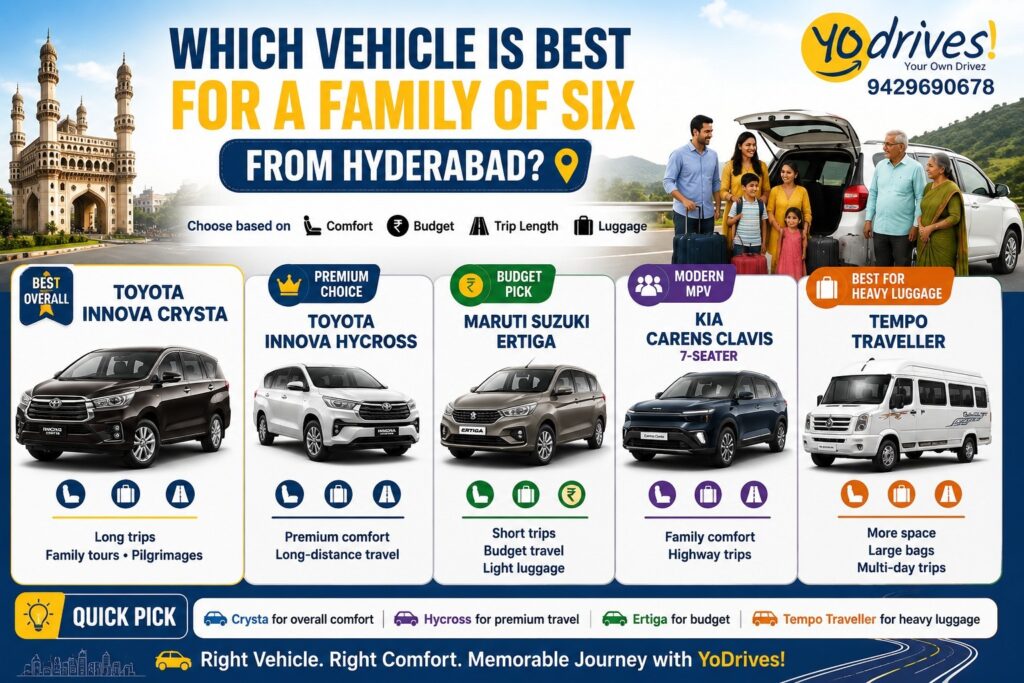
For most six-passenger groups travelling with a driver, the Toyota Innova Crysta is one of the best overall choices. It offers a good balance of passenger space, highway comfort and luggage practicality. If you want a more premium experience, the Toyota Innova Hycross is a strong option, while the Maruti Suzuki Ertiga can be a practical choice for shorter trips and budget-conscious travellers.
For groups carrying a lot of luggage or looking for more space, a Tempo Traveller may be more suitable.
This guide compares the best vehicles for six people travelling from Hyderabad and explains which vehicle works best for popular destinations such as Srisailam, Tirupati, Warangal, Vijayawada, Bengaluru and Hampi.
Quick Answer: Which Is the Best Car for 6 People from Hyderabad?
For most families and groups, Innova Crysta is the best starting point when choosing a car for six people from Hyderabad.
How Many Seats Do You Need for 6 People?
Before booking, there is one important detail to understand.
If you have six passengers and one driver, there are seven people travelling in total.
6 passengers + 1 driver = 7 occupants
Therefore, when booking a chauffeur-driven vehicle, you should confirm the vehicle’s total seating capacity and whether the quoted capacity includes the driver.
A seven-seat vehicle is generally the appropriate configuration for six passengers travelling with a driver.
This is especially important when comparing vehicles marketed as six-seaters and seven-seaters. For example, the Kia Carens Clavis is available in six-seat and seven-seat layouts. If you have six passengers plus a driver, you should specifically request the seven-seat configuration.
1. Toyota Innova Crysta – Best Overall Car for 6 People
The Toyota Innova Crysta is one of the most practical choices for six passengers travelling from Hyderabad, particularly when the journey involves several hours on the road.
Its combination of cabin space, comfortable seating and long-distance practicality makes it suitable for family vacations, pilgrimages and outstation trips.
Why Choose Innova Crysta?
With six passengers and a driver, all three seating rows may be occupied. A larger MPV such as the Innova Crysta provides more room than many smaller vehicles, which can make a long journey more comfortable.
It is particularly suitable for:
Family road trips
Temple visits
Long-distance journeys
Multi-day holidays
Trips with senior citizens
Airport transfers followed by outstation travel
Telangana and Andhra Pradesh tours
Popular Trips from Hyderabad
Hyderabad to Srisailam: A good choice when comfort is important, especially for families travelling with parents or senior citizens.
Hyderabad to Tirupati: The longer journey makes passenger comfort and luggage space more important. Innova Crysta is a strong practical choice.
Hyderabad to Bengaluru: Suitable for groups spending many hours on the road.
Hyderabad to Hampi: A larger MPV can be useful for a multi-day trip where passengers are carrying more luggage.
Hyderabad to Vijayawada: Both Innova Crysta and smaller MPVs can work, but the Innova offers additional comfort for groups travelling with adults or senior citizens.
Best For
Long distance family trips where comfort and practicality are the priority.
2. Toyota Innova Hycross – Best Premium Car for 6 People
If your priority is a more premium travel experience, consider the Toyota Innova Hycross.
The Hycross is available in seven- and eight-seat versions across different variants. Seven-seat versions use captain seats in the second row, while eight-seat versions use a bench arrangement.
For six passengers travelling with a driver, a suitable seven-seat configuration can provide a comfortable arrangement.
Why Choose Innova Hycross?
The Hycross is particularly attractive for:
Premium family trips
Business travel
Corporate journeys
Senior citizens
Families with children
Long highway journeys
Multi-day road trips
The extra comfort can become more valuable as the journey gets longer.
Popular Trips from Hyderabad
The Hycross is a good option for longer routes such as:
Hyderabad to Tirupati
Hyderabad to Bengaluru
Hyderabad to Srisailam
Hyderabad to Hampi
Multi-day road trips
Best For
Travellers who want premium comfort and are willing to spend more than they would on a budget MPV.
3. Maruti Suzuki Ertiga – Best Budget Car for 6 People
Not every six-person trip requires an Innova.
For shorter journeys and travellers who want to control their transportation budget, the Maruti Suzuki Ertiga can be a practical option.
The Ertiga is a seven-seat MPV, making it suitable for six passengers plus a driver.
However, there is an important trade-off: when all three rows are occupied, luggage space is more limited.
When Should You Choose an Ertiga?
The Ertiga works particularly well when:
The trip is relatively short
Passengers have limited luggage
You are travelling on a budget
The group is going sightseeing
Most passengers are carrying backpacks or small bags
Popular Trips from Hyderabad
An Ertiga can be a practical choice for:
Hyderabad city sightseeing
Hyderabad to Warangal
Hyderabad to Nagarjuna Sagar
Hyderabad to Vikarabad
Hyderabad to Yadadri
Short weekend trips
For a multi-day trip with six large suitcases, however, a larger vehicle may be more comfortable.
Best For
Budget-conscious travellers with limited luggage.
4. Kia Carens Clavis – Comfortable Family Alternative
The Kia Carens Clavis is another option for families looking for a modern MPV.
It is available in six-seat and seven-seat configurations. The six-seat layout uses a 2+2+2 arrangement, while the seven-seat layout uses a 2+3+2 arrangement.
For six passengers plus a driver, choose the seven seat configuration.
Depending on the variant, the vehicle offers features such as rear air vents, reclining third-row seats and USB Type-C charging ports.
Popular Trips from Hyderabad
The Carens Clavis can be considered for:
Hyderabad to Warangal
Hyderabad to Vijayawada
Hyderabad to Srisailam
Family weekend trips
City-to-highway travel
Best For
Families looking for a modern MPV with passenger focused features.
5. Tempo Traveller – Best for Heavy Luggage and Extra Space
A Tempo Traveller may sound excessive for only six people, but it can make sense in specific situations.
The main reason to choose one is space, rather than simply passenger capacity.
Consider a Tempo Traveller When:
Six passengers have several large suitcases
You are travelling for several days
Senior citizens need additional space
Passengers want more room during a long journey
You are carrying photography or other equipment
The trip involves multiple destinations
For example, six people travelling for several days with large suitcases may find a spacious vehicle more convenient than filling every available luggage area in a smaller MPV.
Popular Trips
A larger vehicle can be useful for:
Hyderabad to Hampi
Hyderabad to Tirupati
Hyderabad to Goa
Multi-day Telangana tours
Telangana and Andhra Pradesh temple tours
Long-distance group trips
Best For
Groups that value extra space and luggage capacity over the lowest possible fare.
Best Vehicle for 6 People from Hyderabad Based on Destination
The best vehicle can change depending on how far you are travelling and how much luggage you have.
Srisailam is a popular pilgrimage and weekend destination from Hyderabad. An Innova Crysta is particularly suitable when families are travelling with parents or senior citizens.
The Hyderabad–Tirupati journey involves many hours on the road, making comfort an important consideration.
For six passengers travelling with luggage, the Innova Crysta provides a practical combination of passenger space and long-distance comfort.
Premium option: Innova Hycross Budget option: Ertiga, when luggage is limited
Hyderabad to Warangal
Recommended: Ertiga or Innova Crysta
For a shorter trip with limited luggage, an Ertiga can help keep the cost down.
If the group includes senior citizens or prefers more passenger space, the Innova Crysta is a better choice.
Hyderabad to Vijayawada
Recommended: Innova Crysta or Ertiga
Both can work for this journey.
Choose the Ertiga when budget is the main consideration and luggage is limited. Choose the Innova Crysta when passenger comfort is more important.
Hyderabad to Bengaluru
Recommended: Innova Crysta or Innova Hycross
For a long road journey such as Hyderabad to Bengaluru, passenger comfort becomes increasingly important.
The Innova Crysta is the practical choice, while the Hycross is worth considering if you want a more premium experience.
Hyderabad to Hampi
Recommended: Innova Crysta
Hampi is better suited to a road-trip approach, particularly if your itinerary involves several days and multiple bags.
An Innova Crysta provides a good balance of passenger comfort and luggage practicality.
For larger amounts of luggage, consider a Tempo Traveller.
What If 6 People Have a Lot of Luggage?
This is one of the most important factors people overlook when booking a vehicle.
Six passengers may fit comfortably in a seven-seater, but six passengers plus six large suitcases are a different situation.
When all three rows are occupied, the remaining luggage area becomes limited.
Before booking, tell the operator:
6 passengers + 4 medium suitcases + 2 backpacks
This gives the operator a much clearer idea of your requirements.
Consider:
Number of suitcases
Suitcase size
Backpacks
Baby stroller
Wheelchair
Shopping bags
Photography equipment
Other large items
If luggage is heavy, an Innova-class vehicle or Tempo Traveller may be more appropriate than a smaller MPV.
How to Choose the Right Vehicle for 6 People
Don’t choose a vehicle based only on its seating capacity.
Consider these five factors.
1. Number of Passengers
Clearly tell the operator that you have six passengers plus a driver.
2. Luggage
Mention the approximate number and size of bags before booking.
3. Journey Distance
A vehicle that works for a short Hyderabad sightseeing trip may not be the best choice for an eight- or ten-hour journey.
4. Passenger Age
Families travelling with children or senior citizens may benefit from a more spacious and comfortable vehicle.
5. Budget
For shorter trips, an Ertiga can help reduce transportation costs. For longer journeys, spending more on a comfortable vehicle can be worthwhile.
Don’t Choose a Car Only by Price
The cheapest vehicle is not necessarily the best option for a long road trip.
Imagine six passengers travelling for eight or ten hours. A small difference in the total fare is divided among six travellers, while the additional comfort of a larger vehicle benefits everyone throughout the journey.
A larger MPV can provide:
Better passenger space
Easier entry and exit
More comfortable third-row seating
Better luggage management
Less fatigue on long journeys
Instead of looking only at the total fare, consider cost per passenger and comfort during the journey.
Which Vehicle Should You Choose?
Choose Innova Crysta if:
You want the best overall option
You are travelling long distance
Senior citizens are travelling
You have moderate luggage
Comfort is important
Choose Innova Hycross if:
You want premium comfort
You are travelling with family or clients
You have a longer journey
Budget is less important than comfort
Choose Ertiga if:
You want an economical option
The journey is shorter
Luggage is limited
You are travelling mainly around Hyderabad or nearby destinations
Choose Kia Carens Clavis if:
You want a modern MPV
You are travelling with family
Passenger convenience is important
You need a suitable seven-seat configuration
Choose a Tempo Traveller if:
You have heavy luggage
You are travelling for several days
You want additional personal space
You are carrying special equipment
Final Verdict: Best Car for 6 People from Hyderabad
For most groups, the Toyota Innova Crysta is one of the best cars for six people travelling from Hyderabad, especially for long-distance family trips, pilgrimages and multi-day road journeys.
The Toyota Innova Hycross is the better choice when premium comfort is the priority.
The Maruti Suzuki Ertiga is a practical budget option for shorter journeys and groups with limited luggage.
The Kia Carens Clavis provides another modern family MPV alternative, while a Tempo Traveller becomes more attractive when luggage and personal space are major concerns.
The simple rule is:
Don’t choose your vehicle based only on passenger count. Consider passengers + driver + luggage + distance + comfort.
Six people travelling 100 kilometres with backpacks have very different requirements from six people travelling 600 kilometres with suitcases.
Frequently Asked Questions
1.What is the best car for 6 people from Hyderabad?
The Toyota Innova Crysta is one of the best overall choices for six passengers travelling with a driver, particularly for long-distance journeys. It offers a good combination of passenger comfort, space and practicality.
2.Is Ertiga enough for 6 people?
Yes. The Ertiga is a seven-seat MPV and can accommodate six passengers plus a driver. However, luggage space becomes more limited when all three rows are occupied.
3.Can 6 people travel in an Innova with a driver?
Yes. Suitable seven- or eight-seat Innova Crysta configurations can accommodate six passengers plus a driver.
4.Should I book a 6-seater or 7 seater for 6 passengers?
If you are travelling with a driver, confirm the vehicle’s total seating capacity before booking. Six passengers plus one driver require seven seating positions.
5.Which is better for 6 people: Innova Crysta or Ertiga?
The Innova Crysta is generally better for long-distance travel and comfort, while the Ertiga is more suitable when budget is the priority and luggage is limited.
6.Is Innova Hycross good for six passengers?
Yes. A suitable seven-seat Hycross configuration can be a comfortable option for six passengers travelling with a driver, particularly when premium comfort is important.
7.Which vehicle is best for six people with lots of luggage?
An Innova-class vehicle is generally more practical than a smaller MPV. If the group has several large suitcases or needs substantial additional space, consider a Tempo Traveller.
8.What is the best vehicle for six senior citizens?
For six senior passengers travelling from Hyderabad, a larger vehicle such as the Innova Crysta or Innova Hycross can provide greater comfort, particularly on long-distance journeys.
9.Which car is best for a Hyderabad to Tirupati trip for six people?
The Innova Crysta is a strong choice because the journey is long and passenger comfort becomes important. The Innova Hycross is a premium alternative, while an Ertiga can work when luggage is limited and budget is the priority.
10.Which car is best for six people travelling from Hyderabad to Srisailam?
The Innova Crysta is a good choice, particularly for families travelling with senior citizens. An Ertiga can be considered when the group wants a more economical option and has limited luggage.
11.Is a Tempo Traveller suitable for only six people?
It can be. While it may not be necessary for every six-person trip, a Tempo Traveller can make sense when the group has heavy luggage, wants additional space or is travelling for several days.
Plan Your Trip with YoDrives
For six passengers travelling from Hyderabad, choose a vehicle based on your destination, luggage and comfort needs. Innova Crysta is a great all-round choice, while Ertiga suits budget trips and Tempo Traveller is ideal when you need extra space.
Planning a visit to Alampur Jogulamba Temple from Hyderabad, Kurnool or another nearby city? This complete travel guide covers everything you need to plan your trip from Jogulamba Temple timings and history to Shakti Peetha significance, Navabrahma Temples, how to reach Alampur, nearby attractions, the best time to visit and a practical one-day itinerary.
Located on the banks of the Tungabhadra River in Telangana, Alampur is much more than a temple destination. It is a place where ancient Chalukyan architecture, Hindu religious traditions and centuries of temple history come together.
For devotees, the main attraction is the revered Jogulamba Devi Temple, traditionally counted among the 18 Maha Shakti Peethas. For history and architecture enthusiasts, the ancient Navabrahma Temples make Alampur equally fascinating.
If you are visiting for the first time, this guide will help you understand why Alampur is important, what to see, when to visit and how to plan your journey comfortably.
Alampur Jogulamba Temple at a Glance
Information
Details
Location
Alampur, Jogulamba Gadwal district, Telangana
Main deity
Goddess Jogulamba
Religious significance
One of the 18 Maha Shakti Peethas
River
Tungabhadra
Historic significance
Major Badami Chalukyan temple heritage site
Nearest railway station
Alampur Road, about 9 km
Hyderabad distance
Approximately 220 km
Best time for darshan
Morning
Best season for sightseeing
October to February
Ideal trip from Hyderabad
One-day or one-night road trip
Important: Temple timings and other visitor information can change during festivals, special occasions and other circumstances. Confirm the latest information with the temple administration before travelling.
Why Is Alampur Jogulamba Temple So Important?
Alampur is one of those destinations where religion and history are inseparable.
The Jogulamba Temple is revered as one of the 18 Shakti Peethas, while the surrounding temple complex preserves some of the most important examples of early Chalukyan temple architecture in Telangana.
The area is also traditionally associated with the meeting of the Tungabhadra and Krishna rivers and is known as Dakshina Kailasam. Telangana Tourism describes Alampur as the western gateway to Srisailam.
So, a trip to Alampur is not simply about visiting one shrine. It gives travellers an opportunity to experience:
A major Shakti shrine
Ancient Shiva temples
Badami Chalukyan architecture
Historic sculptures and inscriptions
The religious landscape around the Tungabhadra
A destination connected with the wider Srisailam pilgrimage tradition
History of Alampur Jogulamba Temple
The history of Alampur goes far beyond the present-day temple building.
The Alampur region preserves ancient temples dating back to the 6th and 7th centuries CE, with the Navabrahma Temples particularly associated with the Badami Chalukyas. The Jogulamba Gadwal District Administration describes the site as an important example of early temple architecture and notes that the temples display a distinctive architectural style dating to this period.
The region was subsequently influenced by several South Indian dynasties, making Alampur an important historical landscape rather than an isolated temple complex.
The district administration also records later historical connections with the Rashtrakutas and Vijayanagara rulers, demonstrating that Alampur continued to have religious and political importance long after the Chalukyan period.
The Badami Chalukyan Connection
One of the most important chapters in Alampur’s history is its connection with the Badami Chalukyas.
The nine Navabrahma Temples were built during the Chalukyan period and are among the site’s most valuable architectural remains. Their stone construction, sculptural details, pillars and temple layouts provide an opportunity to see the development of early South Indian temple architecture.
The district administration dates the wider Navabrahma temple group to the 6th–7th centuries CE, while the Bala Brahma Temple carries inscriptions indicating a date around 702 CE.
This makes Alampur particularly interesting for visitors who want to combine a pilgrimage with a glimpse into the architectural history of the Deccan.
Why Is Jogulamba a Shakti Peetha?
The religious importance of Alampur comes primarily from Goddess Jogulamba.
The temple is traditionally regarded as the 5th Shakti Peetha among the 18 Shakti Peethas. Telangana Tourism and the Jogulamba Gadwal district administration both identify Jogulamba Temple as one of the 18 Shakti Peethas.
According to the traditional Shakti Peetha belief, these sacred sites are associated with parts of Goddess Sati’s body. Telangana Tourism’s pilgrimage material identifies Alampur with the belief that Sati Devi’s upper teeth fell here.
For devotees, this belief gives the shrine a significance that extends beyond the local region.
Who Is Goddess Jogulamba?
The name Jogulamba is associated with the Telugu expression “Yogula Amma,” meaning Mother of Yogis.
The district administration describes the goddess as a powerful form associated with yogic siddhi and notes the distinctive iconography of the deity. Telangana Tourism similarly connects Jogulamba with the form of Yogini or Jogulamba.
This unique identity is one of the reasons the shrine stands apart from many other Goddess temples in South India.
Legends and Spiritual Traditions of Alampur
Alampur’s religious history is also connected with several traditional legends.
One important tradition tells of Brahma performing intense penance at Alampur, after which Lord Shiva granted him the powers of creation. This tradition is associated with the name Brahmeswara, while the goddess is associated with Yogini or Jogulamba.
Another traditional account recorded by the district administration connects the construction of the Nava Brahma temples with the legendary figure Rasa Siddha and the Chalukyan period. These accounts form part of the local religious and cultural traditions surrounding the temples.
When visiting Alampur, these legends add another dimension to the stone temples and sculptures around you.
The Navabrahma Temples of Alampur
If you have travelled all the way to Alampur, don’t stop after visiting Jogulamba Temple.
The Navabrahma Temples are one of the biggest historical attractions of the destination.
The nine temples are:
Taraka Brahma
Swarga Brahma
Padma Brahma
Bala Brahma
Garuda Brahma
Kumara Brahma
Arka Brahma
Vira Brahma
Vishwa Brahma
The temples are dedicated to Lord Shiva and are enclosed within a historic temple complex near the Tungabhadra.
Bala Brahma Temple
The Bala Brahma Temple is the principal shrine among the Navabrahma group.
According to the Jogulamba Gadwal district administration, inscriptions at the temple indicate a date of 702 CE. The temple continues to be an important place of worship, with Maha Shivaratri celebrated with particular importance.
Swarga Brahma Temple
The Swarga Brahma Temple is known for its imposing tower and detailed sculptural work. The district administration describes it as one of the finest examples within the Alampur group.
Vishwa Brahma Temple
The Vishwa Brahma Temple is noted for its artistic character and is another important stop for visitors interested in Chalukyan architecture.
Why Should You Explore the Navabrahma Temples?
Because they transform the Alampur experience from a short temple visit into a heritage journey.
You can see:
Ancient stone architecture
Sculptural details
Historic inscriptions
Different temple designs
Chalukyan artistic traditions
Centuries-old religious heritage
If you enjoy history, architecture or photography, keep additional time for this part of Alampur.
Alampur Jogulamba Temple Timings
The official temple website currently lists:
Temple
Timing
Sri Jogulamba Devi Temple
6:30 AM–8:30 PM
Sri Bala Brahmeswara Swamy Temple
6:00 AM–8:30 PM
Afternoon break
1:00 PM–2:00 PM
The Jogulamba Gadwal district administration lists general visitor timings as 7:00 AM–1:00 PM and 2:00 PM–8:30 PM.
Because official sources currently show slightly different opening times, visitors should confirm the exact darshan schedule before travelling, particularly on festival days.
Temple contact: 08502-241327
What Is the Best Time for Darshan?
For most visitors, early morning is the best time for darshan.
Morning visits can be more comfortable because:
Temperatures are generally lower.
The surroundings are quieter.
You can complete the main darshan before exploring the heritage sites.
You have more time for the rest of your itinerary.
Families with children and senior citizens can avoid the strongest afternoon heat.
Crowds can increase during important religious occasions such as Maha Shivaratri and Navaratri, as well as on weekends and other busy days.
How Much Time Do You Need at Alampur?
Your ideal visit duration depends on your purpose.
Only Jogulamba Temple
Allow around 1–2 hours, depending on the crowd and darshan requirements.
Jogulamba + Bala Brahmeswara
Allow approximately 2–3 hours for a more relaxed visit.
Full Temple and Heritage Visit
If you want to explore the Navabrahma Temples and other attractions, keep approximately 4–6 hours or more.
For travellers coming from Hyderabad, this is why an early morning departure is recommended.
How to Reach Alampur Jogulamba Temple
By Road
Alampur is easily accessible by road and is approximately 220 km from Hyderabad, according to the Jogulamba Gadwal district administration. It is accessible through the Hyderabad–Bengaluru highway.
Approximate road distances include:
Starting Point
Approx. Distance
Approx. Travel Time
Kurnool
27 km
Around 45 minutes–1 hour
Gadwal
35–40 km
Around 1 hour
Hyderabad
Around 220 km
Around 4–5 hours
Raichur
70–80 km
Around 1.5–2 hours
Bengaluru
330–350 km
Around 6–7 hours
Actual travel time depends on your starting location, traffic, route and road conditions.
Hyderabad to Alampur by Car
For travellers starting from Hyderabad, Alampur works well as a same day pilgrimage or one night road trip.
If you want to complete the trip in one day, an early departure is important.
Suggested departure
4:30–5:30 AM from Hyderabad
This gives you enough time to reach Alampur in the morning, complete darshan and explore the surrounding temples before starting your return journey.
A private cab can be particularly convenient because you can:
Start at your preferred time.
Stop for breakfast.
Travel with children and senior citizens comfortably.
Carry luggage easily.
Visit several attractions in one trip.
Avoid changing between multiple transport options.
Kurnool to Alampur
Kurnool is one of the closest major cities to Alampur.
The road distance is approximately 27 km, making it possible to visit Alampur from Kurnool as a short half-day or full-day excursion.
Travellers arriving in Kurnool by train or bus can continue to Alampur by local transport or private cab.
Alampur by Train
Alampur Road Railway Station is the nearest railway station and is approximately 9 km from Alampur.
Before planning your journey around this station, check the latest train schedules and stoppages.
Alampur by Air
Rajiv Gandhi International Airport, Hyderabad is the nearest major airport option mentioned by the district administration and is approximately 200 km away.
Travellers can continue from the airport by cab or plan an overnight stay in Hyderabad before beginning their road journey.
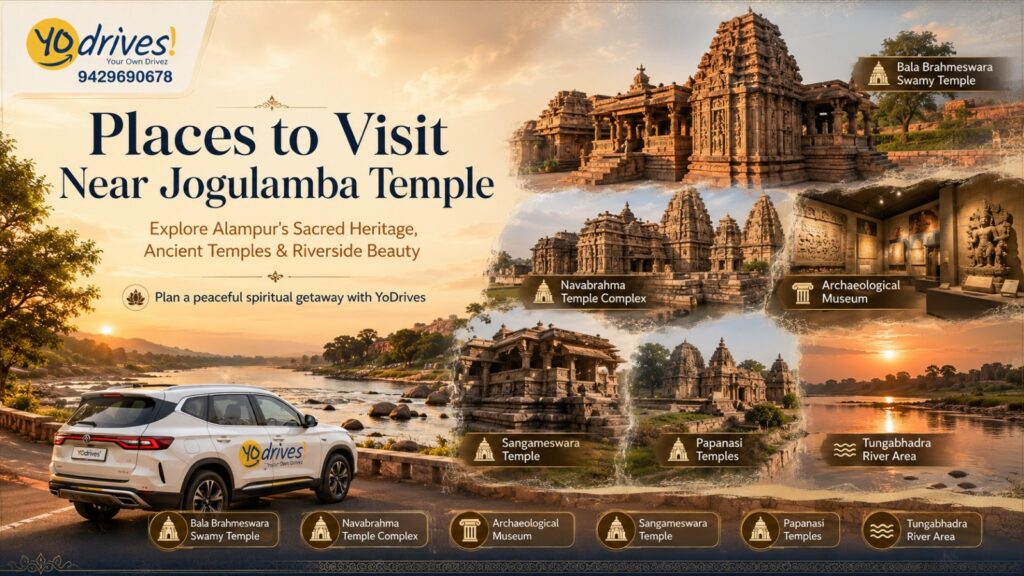
Places to Visit Near Jogulamba Temple
Bala Brahmeswara Swamy Temple
One of Alampur’s principal Shiva temples and an important part of the religious heritage of the town.
Navabrahma Temples
The nine ancient Shiva temples are among the biggest reasons to spend extra time in Alampur.
Archaeological Museum
The museum contains sculptures and archaeological material associated with Alampur’s temple heritage.
Sangameswara Temple
The historic Sangameswara Swamy Temple is associated with the confluence of the Krishna and Tungabhadra rivers and was relocated as part of conservation efforts connected with the Srisailam project. The temple is now an additional heritage attraction in the region.
Tungabhadra River Area
The riverside setting adds to the spiritual atmosphere of Alampur. Visitors should use safe and authorised access points, particularly when water levels are high.
Best Time to Visit Alampur
October to February
This is generally the more comfortable period for combining temple visits with heritage sightseeing.
March to June
Summer can be hot, especially during the afternoon. Early morning visits are preferable.
Monsoon
The landscape can become greener, but travellers should check weather and road conditions before travelling.
Festival Periods
Maha Shivaratri, Navaratri and other religious occasions can bring larger crowds. Plan additional time for darshan and parking.
What to Carry for Your Temple Visit
A little preparation can make your trip much easier.
Drinking water
Modest and comfortable clothing
Some cash
Comfortable footwear
Phone charger or power bank
Essential medicines
Sunglasses or a cap during summer
Identification documents if required
Extra time for queues and security checks
Is Alampur Suitable for a Family Trip?
Yes.
Alampur can work particularly well for families who want to combine pilgrimage, heritage and a road trip.
Instead of visiting only Jogulamba Temple, families can explore the Bala Brahmeswara Temple and Navabrahma Temples at a comfortable pace.
If you are travelling with children or senior citizens, avoid scheduling too many outdoor activities during the afternoon.
Which Vehicle Is Best for a Hyderabad to Alampur Trip?
Your ideal vehicle depends on the number of travellers.
2–3 people
A sedan can be suitable for a small group.
4–5 people
An SUV provides additional space and comfort.
6–7 people
A spacious MUV can be more comfortable, particularly when travelling with luggage.
Family with children
Choose a vehicle with enough legroom and luggage space for a long road journey.
Hyderabad to Alampur One Day Itinerary
Here is a practical itinerary for travellers who want to complete the trip in one day.
4:30–5:00 AM Depart from Hyderabad
8:30–9:30 AM Arrive in Alampur
9:30–10:30 AM Jogulamba Devi Temple darshan
10:30–11:30 AM Bala Brahmeswara Swamy Temple
11:30 AM–1:00 PM Explore the Navabrahma Temples
1:00–2:00 PM Lunch and rest
2:00–3:30 PM Visit the museum or another nearby attraction
4:00 PM Begin the return journey
8:00–9:00 PM Reach Hyderabad
This is an indicative schedule. During festivals and busy weekends, allow additional time.
The one-night option is more relaxed and may be preferable for families.
Frequently Asked Questions
What are the Alampur Jogulamba Temple timings?
The official temple website lists Jogulamba Devi Temple as 6:30 AM–8:30 PM, with a 1:00 PM–2:00 PM break. The district administration lists general visitor timings as 7:00 AM–1:00 PM and 2:00 PM–8:30 PM. Confirm the latest schedule before travelling.
Why is Jogulamba Temple famous?
Jogulamba Temple is revered as one of the 18 Maha Shakti Peethas and is traditionally regarded as the 5th Shakti Peetha.
What is the history of Alampur?
Alampur has a long history associated with several South Indian dynasties. Its ancient temples, particularly the Navabrahma group, are strongly associated with the Badami Chalukyas and date to the early medieval period.
What are the Navabrahma Temples?
The Navabrahma Temples are a group of nine ancient Shiva temples at Alampur associated with Badami Chalukyan architecture.
How far is Alampur from Hyderabad?
Alampur is approximately 220 km from Hyderabad, with the road journey generally taking around 4–5 hours depending on traffic and route.
How far is Alampur from Kurnool?
Alampur is approximately 27 km from Kurnool.
Which railway station is nearest to Alampur?
Alampur Road Railway Station is approximately 9 km away.
Can Alampur be covered in one day from Hyderabad?
Yes. An early start from Hyderabad makes a same-day Alampur pilgrimage possible.
How much time should I spend at Alampur?
For the main temples, a few hours may be sufficient. If you want to explore the Navabrahma Temples and nearby attractions properly, plan for 4–6 hours or more.
What is the best time to visit Alampur?
October to February is generally more comfortable for sightseeing. During summer, early morning is preferable.
Can I visit Alampur with children and senior citizens?
Yes. Plan the visit around morning darshan, avoid the hottest afternoon hours and allow enough time for rest.
Is a cab better for a Hyderabad to Alampur family trip?
A private cab can be convenient because it provides flexible departure times, doorstep pickup, stops during the journey and easier access to multiple attractions.
Plan Your Alampur Road Trip with YoDrives
After planning your temple visits, the next step is choosing a comfortable way to get there.
For travellers from Hyderabad, Kurnool and nearby cities, a private cab can make the journey easier especially when travelling with family, children or senior citizens.
With YoDrives, you can choose an intercity cab option based on your group size and travel requirements.
Why Choose YoDrives?
Doorstep pickup and drop
One-way and round-trip cab options
Sedan, SUV and larger vehicle options
Comfortable travel for families and groups
Flexible stops during the journey
Convenient travel for temple and heritage sightseeing
Experienced drivers for intercity journeys
Whether you are planning a Hyderabad to Alampur one day trip, a family pilgrimage or an Alampur–Kurnool road trip, the right vehicle can make the journey more comfortable.
Customer Testimonials
Final Thoughts
Alampur Jogulamba Temple is a destination where faith, history and architecture come together.
The importance of Alampur goes far beyond its famous Goddess temple. The site’s connection with the Shakti Peetha tradition, the ancient Navabrahma Temples, the Badami Chalukyan architectural heritage and the religious traditions surrounding the Tungabhadra make it a destination worth exploring slowly rather than rushing through.
Ready to plan your Alampur trip? Book a comfortable cab with YoDrives for a hassle-free journey.
Explore the best sunrise drives near Hyderabad, including Ananthagiri Hills, Bhongir Fort, Singur, Medak, Rachakonda and more. Plan your road trip with YoDrives.
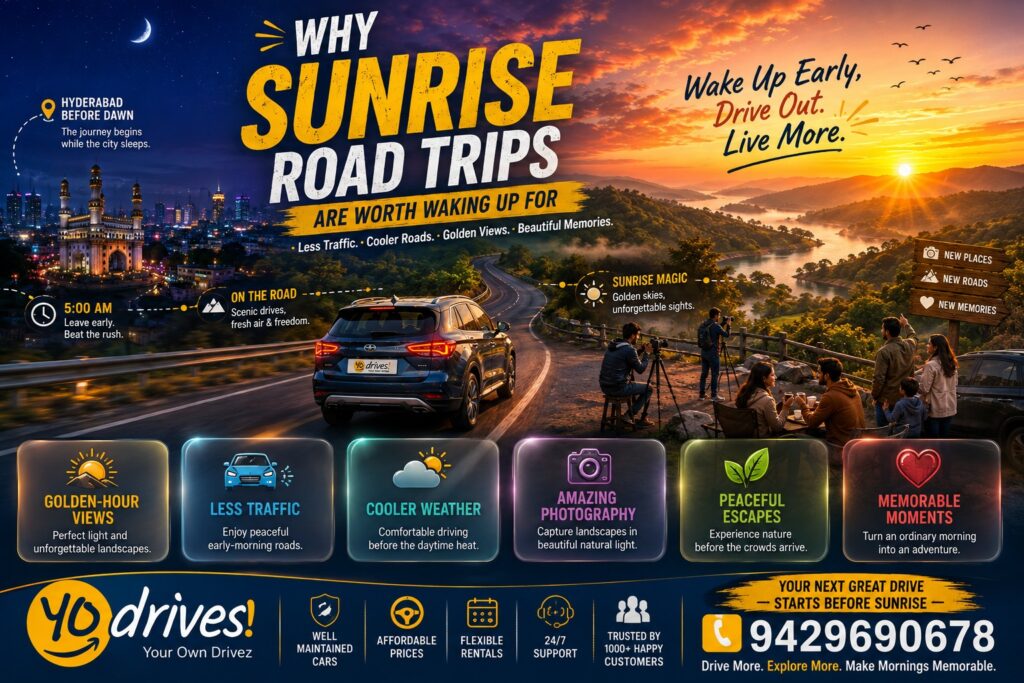
Planning an early-morning escape from Hyderabad? A sunrise road trip is a great way to enjoy quieter roads, cooler weather, scenic landscapes, and a peaceful start to the day. From forest-covered hills and historic forts to lakes and reservoirs, there are several destinations within driving distance of Hyderabad that can make an early morning memorable.
Whether you’re planning a couple’s outing, family trip, solo drive, photography session, or weekend getaway, choosing the right destination can make all the difference.
In this guide, we’ll explore some of the best sunrise drives near Hyderabad, including Ananthagiri Hills, Bhongir Fort, Osman Sagar, Singur Dam, Medak, Koilkonda Fort, Pocharam Wildlife Sanctuary, Nagarjuna Sagar, Rachakonda Fort, and Somasila.
We’ve also included approximate distances, what you can expect at each destination, who each route is best suited for, and practical tips to help you plan your early-morning road trip.
If you’re looking for a comfortable vehicle for the journey, YoDrives offers self drive and chauffeur driven rental options in Hyderabad, making it easier to choose a vehicle that fits your trip and group size.
Why Choose a Sunrise Drive from Hyderabad?
A sunrise road trip offers a different experience from a typical weekend outing. Leaving the city early means you can enjoy the journey before the roads become busy and reach your destination while the morning is still peaceful.
Here are some reasons to consider an early-morning road trip:
Less traffic: Roads are generally quieter during the early hours.
Pleasant weather: Morning temperatures can be more comfortable, particularly during warmer months.
Beautiful photography: Soft morning light can make hills, lakes, forts, and countryside landscapes especially photogenic.
Peaceful surroundings: Starting early gives you more time to enjoy nature before popular destinations become busy.
Short getaway: Several destinations can be explored as a morning or one-day trip from Hyderabad.
More time to explore: Reaching early can leave you with most of the day to visit nearby attractions.
How Early Should You Start?
Your departure time depends on the destination, the expected driving time, and whether you need to walk or trek to reach a viewpoint.
For a nearby destination, leaving 60–90 minutes before sunrise may be sufficient. For destinations farther from Hyderabad or places involving a climb, plan to leave considerably earlier.
Before starting your journey, check the sunrise time, weather conditions, route, fuel availability, and destination access timings.
Tip: Don’t plan to reach the destination exactly at sunrise. Allow extra time for parking, walking, finding a suitable viewing spot, and unexpected delays.
Best Sunrise Drives Near Hyderabad
From quick morning escapes to longer road trips, these destinations offer different experiences depending on how far you want to travel and what you want to do after sunrise.
1. Ananthagiri Hills
Approximate distance from Hyderabad: 75–80 km Best for: Nature lovers, couples, families, photographers, and short weekend road trips
Located near Vikarabad, Ananthagiri Hills is one of the most popular scenic destinations for an early-morning drive from Hyderabad. The route takes you away from the city’s busy streets and into a greener landscape of forested hills, winding roads, and peaceful surroundings.
For travellers who enjoy the journey as much as the destination, the drive itself is one of the highlights. Starting early allows you to experience the quieter roads and cooler morning air before spending the rest of the day exploring the area.
What Makes Ananthagiri Hills a Good Morning Drive?
The combination of greenery, elevated terrain, and winding roads makes Ananthagiri Hills particularly attractive for a morning road trip. The landscape can look especially scenic during the cooler and wetter months.
Depending on the route and access conditions, you can combine your visit with nearby attractions and nature spots rather than treating it only as a sunrise stop.
Things to Do in Ananthagiri Hills
Enjoy a scenic early-morning drive
Explore the forested surroundings
Visit Anantha Padmanabha Swamy Temple
Take photographs of the hills and countryside
Explore suitable walking or trekking areas
Stop for breakfast at a suitable local spot
Who Is It Best For?
Ananthagiri Hills is a good option if you’re looking for a short road trip from Hyderabad without committing to a very long drive. It works well for couples, families, photographers, groups of friends, and anyone looking for a peaceful break from the city.
Road Trip Tip
If sunrise is your main goal, don’t assume that simply reaching Ananthagiri Hills at sunrise will give you the best view. Choose your intended viewpoint beforehand and allow additional time for parking, walking, and finding a suitable spot.
YoDrives Tip: A comfortable hatchback or sedan can work well for a small group, while an SUV can be a better choice if you’re travelling with more passengers or luggage.
2. Koilkonda Fort
Approximate distance from Hyderabad: 125 km Best for: History lovers, hikers, photographers, and adventure travellers
If you’re comfortable starting early and travelling farther from Hyderabad, Koilkonda Fort can turn a sunrise outing into an adventurous road trip.
Located in the Mahabubnagar region, Koilkonda Fort stands on a hill and is surrounded by rugged terrain and countryside landscapes. The Telangana government places the fort at approximately 125 km from Hyderabad and notes that reaching the fort involves navigating the surrounding terrain and climbing steps.
Why Visit Koilkonda Fort Early in the Morning?
An early start can make the climb more comfortable than attempting it later in the day, particularly during warmer months. The softer morning light also creates interesting conditions for photographing the fort, rocky terrain, and surrounding countryside.
However, this isn’t a destination where you should plan to arrive at the last minute. If you want to experience the area around sunrise, allow enough time for the drive, parking, walking, and climb.
Things to Do at Koilkonda Fort
Explore the historic fort
Walk through the surrounding hill landscape
Photograph the fort and countryside
Enjoy panoramic views from suitable areas
Combine the visit with other attractions in the region
Who Is It Best For?
Koilkonda Fort is better suited to adventure travellers, hikers, history enthusiasts, and photographers than travellers looking for a quick roadside sunrise stop.
Families with young children or travellers who aren’t comfortable with uneven terrain may prefer an easier destination such as Osman Sagar or Medak.
Road Trip Tip
Start much earlier than you would for nearby destinations. Check the route and local access conditions before travelling, and carry sufficient drinking water and comfortable footwear.
YoDrives Tip: For a longer road trip such as Koilkonda, choose a vehicle with enough cabin space and luggage capacity for everyone travelling. A comfortable sedan or SUV can make the extended drive more enjoyable.
3. Osman Sagar (Gandipet Lake)
Approximate distance from Hyderabad: 20–30 km Best for: Couples, families, morning walkers, photographers, and quick weekend escapes
If you don’t want to spend several hours on the road, Osman Sagar, also known as Gandipet Lake, is one of the more convenient options for an early-morning outing from Hyderabad.
Its proximity to the city makes it suitable for travellers who want to leave early, enjoy the morning atmosphere around the reservoir, and still return home with most of the day ahead.
Why Choose Osman Sagar for a Sunrise Drive?
The reservoir and surrounding landscape provide a calmer setting away from Hyderabad’s busy roads. Early morning can be a particularly pleasant time to enjoy the area before daytime activity increases.
Instead of planning a full-day road trip, you can treat Osman Sagar as a short morning drive, perhaps followed by breakfast or another nearby attraction.
Things to Do Around Osman Sagar
Enjoy the early-morning lakeside scenery
Take photographs
Go for a morning walk where permitted
Explore nearby areas
Combine the outing with breakfast
Look for birds around suitable areas
Who Is It Best For?
Osman Sagar is ideal for anyone searching for short sunrise drives near Hyderabad. It’s particularly convenient for couples, families, photographers, and people who don’t want to spend a large part of the day travelling.
Road Trip Tip
Because Osman Sagar is close to Hyderabad, you don’t need to plan an extremely early departure. However, leave enough buffer to account for your starting point within the city and the exact location you intend to visit.
Also check current access conditions before travelling, as not every section around a reservoir is necessarily open to visitors at all times.
YoDrives Tip: For a small group, a hatchback or sedan can be a practical choice for this short drive. If you’re travelling with a larger group, consider a spacious SUV or group vehicle instead.
4. Singur Dam
Approximate distance from Hyderabad: 90–100 km Best for: Nature lovers, photographers, couples, and relaxed weekend road trips
Looking for a scenic drive near Hyderabad that takes you away from the city’s traffic and into a quieter landscape? Singur Dam is a good option for travellers who enjoy reservoir views, open countryside, and a slower-paced morning.
Located in the Sangareddy region, the Singur reservoir is surrounded by a largely rural landscape. The open skies and water views can make the area appealing for early-morning photography and peaceful road trips.
Why Visit Singur Early in the Morning?
Starting early helps you enjoy the drive before the roads become busier and gives you more time to explore the surrounding area during comfortable morning temperatures.
The combination of the reservoir, countryside, and changing morning light can make the journey particularly enjoyable for photographers and nature lovers.
Things to Do Around Singur
Enjoy views of the reservoir
Photograph the morning landscape
Explore the surrounding countryside
Take a relaxed road trip
Look for birds and other local wildlife from appropriate areas
Combine the trip with other attractions around Sangareddy
Who Is It Best For?
Singur Dam is a good choice for couples, photographers, nature lovers, and anyone looking for a peaceful weekend drive from Hyderabad.
It can also work well for travellers who want something farther away than Osman Sagar without committing to a very long-distance road trip.
Road Trip Tip
Before leaving Hyderabad, check the weather and route conditions. Carry drinking water and snacks, and make sure your vehicle has enough fuel, particularly if you plan to explore areas beyond the main route.
Avoid entering restricted areas around the reservoir and follow local instructions when visiting.
YoDrives Tip: A sedan or SUV can be a comfortable choice for the journey. If you’re travelling with friends or family, select a vehicle based on the number of passengers and luggage rather than choosing only by distance.
5. Medak Fort & Medak Cathedral
Approximate distance from Hyderabad: 95–100 km Best for: Families, history enthusiasts, photographers, and one-day road trippers
If you want your early-morning drive to become a full day of sightseeing, Medak is a strong option. Located around 100 km from Hyderabad, the town combines historical attractions, architecture, and countryside scenery.
Instead of making the entire trip about sunrise, you can start early, enjoy the drive, and then spend the rest of the day exploring Medak’s major attractions.
Why Include Medak in a Sunrise Road Trip?
The countryside becomes an important part of the experience when you leave Hyderabad early. Once you reach Medak, you can continue exploring its historical and architectural attractions.
Medak Fort offers an opportunity to explore the region’s history, while Medak Cathedral is known for its distinctive Gothic-style architecture.
This makes Medak particularly useful for travellers who want more than a scenic viewpoint.
Things to Do in Medak
Explore Medak Fort
Visit Medak Cathedral
Photograph the architecture and surrounding landscapes
Enjoy a local breakfast
Explore nearby attractions
Turn the sunrise drive into a full-day road trip
Who Is It Best For?
Medak works well for families, couples, history lovers, photographers, and groups of friends looking for a one-day trip from Hyderabad.
It’s also a good alternative if you prefer sightseeing and cultural attractions over trekking or hiking.
Road Trip Tip
Start early enough to enjoy the drive without rushing. If you’re planning to visit multiple attractions, check their current opening times before setting out.
YoDrives Tip: For a family or group day trip, choose a vehicle with enough seating and luggage space. A comfortable sedan or SUV can make the approximately 100 km journey easier, especially if you plan to spend the entire day exploring.
6. Bhongir Fort
Approximate distance from Hyderabad: 50 km Best for: Adventure lovers, history enthusiasts, photographers, couples, and short road trips
Rising dramatically from a massive monolithic hill, Bhongir Fort is one of the most distinctive historical destinations within easy driving distance of Hyderabad.
Its relatively short distance makes it a practical option for travellers who want an early morning road trip near Hyderabad without spending several hours on the highway.
Why Visit Bhongir Fort Early in the Morning?
The fort involves a climb, so starting early can be more comfortable than attempting the ascent later in the day. The elevated location also provides broad views of the surrounding countryside.
For photographers, the combination of the rocky hill, historic fort structures, and soft morning light can create interesting opportunities for landscape photography.
Things to Do at Bhongir Fort
Explore the historic fort
Climb the hill
Enjoy panoramic countryside views
Photograph the fort and surrounding landscape
Spend a relaxed morning away from the city
Explore other attractions around Bhongir if time permits
Who Is It Best For?
Bhongir Fort is particularly suitable for couples, groups of friends, history lovers, photographers, and adventure seekers.
If you’re travelling with elderly family members or young children, consider the physical effort involved in reaching the upper sections before choosing this destination.
Road Trip Tip
Don’t plan to reach the fort at exactly sunrise. Allow extra time for parking, walking to the base, and climbing the hill. Wear comfortable footwear and carry drinking water.
Always follow local safety instructions and avoid climbing unstable or restricted sections.
YoDrives Tip: Bhongir is close enough for a quick morning drive, so a hatchback or sedan can be practical for smaller groups. For families or larger groups, choose a vehicle with sufficient seating and comfortable space for the journey.
7. Pocharam Wildlife Sanctuary
Approximate distance from Hyderabad: Around 110–115 km Best for: Nature lovers, birdwatchers, wildlife enthusiasts, and photographers
If your idea of a sunrise road trip involves forests, water, birds, and peaceful surroundings rather than forts or busy tourist attractions, Pocharam Wildlife Sanctuary is worth considering.
Located in the Medak region, the sanctuary surrounds Pocharam Lake and offers a combination of woodland and wetland habitats. The Government of Telangana highlights the sanctuary’s birdlife and variety of wildlife, making it an interesting destination for nature-focused travellers.
Why Visit Pocharam in the Morning?
Early morning is a natural choice for wildlife and birdwatching because the surroundings are generally quieter and wildlife activity can be more noticeable than during the hotter parts of the day.
The combination of the lake, vegetation, and open landscape also provides opportunities for nature photography.
However, this should be treated as a nature trip rather than a guaranteed sunrise viewpoint. Access to particular areas may depend on current sanctuary rules and timings.
Things to Do at Pocharam
Enjoy the natural surroundings
Try birdwatching
Take nature photographs
Explore permitted areas around the sanctuary
Visit the lake and surrounding landscape where access is allowed
Combine the visit with other attractions in the region
Who Is It Best For?
Pocharam is particularly suitable for birdwatchers, photographers, families interested in nature, and travellers looking for a quieter alternative to popular weekend destinations.
Road Trip Tip
Check the sanctuary’s current entry timings, access rules, and local conditions before travelling. Wildlife areas can have restrictions that make very early access unsuitable.
Carry water, comfortable footwear, and a camera if you’re interested in photography. Most importantly, maintain a safe distance from wildlife and follow instructions from local authorities or sanctuary staff.
YoDrives Tip: For a 100+ km road trip, comfort becomes more important than simply choosing the smallest vehicle. A sedan or SUV can be a good choice for couples, families, or small groups spending several hours on the road.
8. Nagarjuna Sagar
Approximate distance from Hyderabad: 150–165 km Best for: Long-distance road trippers, families, couples, photographers, and weekend travellers
If you enjoy spending several hours on the road and want your sunrise outing to become a full-day experience, Nagarjuna Sagar is one of the longer road trips you can consider from Hyderabad.
The massive reservoir, surrounding landscapes, and nearby historical and cultural attractions give you plenty to explore beyond the early-morning views.
Why Choose Nagarjuna Sagar for a Sunrise Road Trip?
The long drive makes Nagarjuna Sagar different from destinations such as Osman Sagar or Bhongir Fort. Rather than treating it as a quick morning stop, plan it as a full day road trip.
Starting early can help you reach the area before the day becomes too warm and leave enough time to explore nearby attractions later.
The reservoir and surrounding landscape can also provide interesting photography opportunities, particularly during softer morning and evening light.
Things to Do Around Nagarjuna Sagar
Enjoy reservoir views
Explore nearby attractions
Visit historical and Buddhist sites in the region
Take photographs
Explore viewpoints where permitted
Consider boating or other activities if they are operating on the day of your visit
Who Is It Best For?
Nagarjuna Sagar is best suited to families, couples, groups of friends, photographers, and travellers who enjoy longer road trips.
It may not be the best choice if you’re looking for a quick two- or three-hour morning outing from Hyderabad.
Road Trip Tip
Because the journey is considerably longer, check your route, fuel stops, weather, and destination timings before leaving. Keep enough time in your schedule for breaks and avoid trying to complete the entire journey without rest.
If you’re planning to visit attractions or go boating, verify their current operating schedules before starting your trip.
YoDrives Tip: For a long-distance drive, prioritize comfort, seating space, luggage capacity, and fuel efficiency. A sedan or SUV can be a practical choice depending on the size of your group.
9. Rachakonda Fort
Approximate distance from Hyderabad: 60–70 km Best for: History lovers, photographers, hikers, and adventure seekers
For travellers who enjoy historic places surrounded by rugged natural landscapes, Rachakonda Fort offers a different kind of early-morning road-trip experience.
Located in the Nalgonda region, the fort is associated with the Velama rulers and sits among rocky hills and open countryside. The combination of historic ruins and natural surroundings makes the area particularly interesting for photography and exploration.
Why Visit Rachakonda Fort in the Morning?
Starting early allows you to explore the area before temperatures rise. The softer morning light can also highlight the rocky terrain and fort remains, creating a more atmospheric setting for photography.
Rather than treating Rachakonda as a guaranteed sunrise viewpoint, consider it a scenic early-morning fort exploration where the surrounding landscape is part of the experience.
Things to Do at Rachakonda Fort
Explore the historic fort remains
Walk through the surrounding rocky landscape
Photograph the ruins and countryside
Enjoy the quieter morning atmosphere
Explore suitable areas around the fort
Combine the visit with other nearby attractions
Who Is It Best For?
Rachakonda is a good choice for history enthusiasts, photographers, hikers, couples, and groups of friends looking for something different from a conventional lake or resort outing.
Travellers who prefer easily accessible locations with minimal walking may find Osman Sagar or other nearby destinations more convenient.
Road Trip Tip
Wear comfortable shoes and be careful on uneven or rocky surfaces. Avoid climbing unstable structures or entering restricted areas. If you’re visiting very early, make sure you have enough daylight before attempting unfamiliar sections of the terrain.
Check current local access conditions before travelling.
YoDrives Tip: Rachakonda is suitable for a short-to-medium road trip from Hyderabad. A hatchback or sedan can work well for smaller groups, while an SUV can provide additional comfort for families or groups travelling with equipment or luggage.
10. Somasila Reservoir
Approximate distance from Hyderabad: 170–180 km Best for: Couples, photographers, nature lovers, and travellers looking for quieter destinations
If you prefer peaceful landscapes over crowded tourist spots, Somasila Reservoir can be considered for a longer road trip from Hyderabad.
Located in the Nagar Kurnool region, Somasila is known for its reservoir and surrounding countryside. The distance makes it less suitable for a quick morning outing, but it can work well for travellers who enjoy long drives and want to spend more time away from the city.
Why Choose Somasila for a Sunrise Road Trip?
The open landscape around the reservoir provides a relaxing setting for an early start. Wide skies, water views, and relatively quiet surroundings can make the journey appealing to photographers and travellers looking for a slower-paced getaway.
Because of the distance, however, you should plan the trip carefully rather than trying to rush from Hyderabad just before sunrise.
Things to Do Around Somasila
Enjoy reservoir and countryside views
Take landscape photographs
Explore permitted areas around the destination
Enjoy a peaceful road trip
Visit nearby attractions if time permits
Consider an overnight stay if you want a more relaxed itinerary
Who Is It Best For?
Somasila is particularly suitable for couples, photographers, nature lovers, and experienced road trippers who don’t mind spending several hours travelling.
For families with young children or travellers looking for a quick sunrise outing, a closer destination may be more practical.
Road Trip Tip
For a destination this far from Hyderabad, consider starting the previous evening or planning an overnight stay if sunrise is the main objective. Check the route, accommodation availability, weather, fuel stops, and local access conditions before travelling.
YoDrives Tip: For a 170+ km journey, prioritize passenger comfort. An SUV or spacious sedan can be a better choice for a long-distance trip, particularly when travelling with several passengers.
Best Sunrise Drives Near Hyderabad at a Glance
Not every sunrise road trip needs the same amount of time or preparation. Some destinations are close enough for a quick morning escape, while others are better planned as full-day or overnight trips.
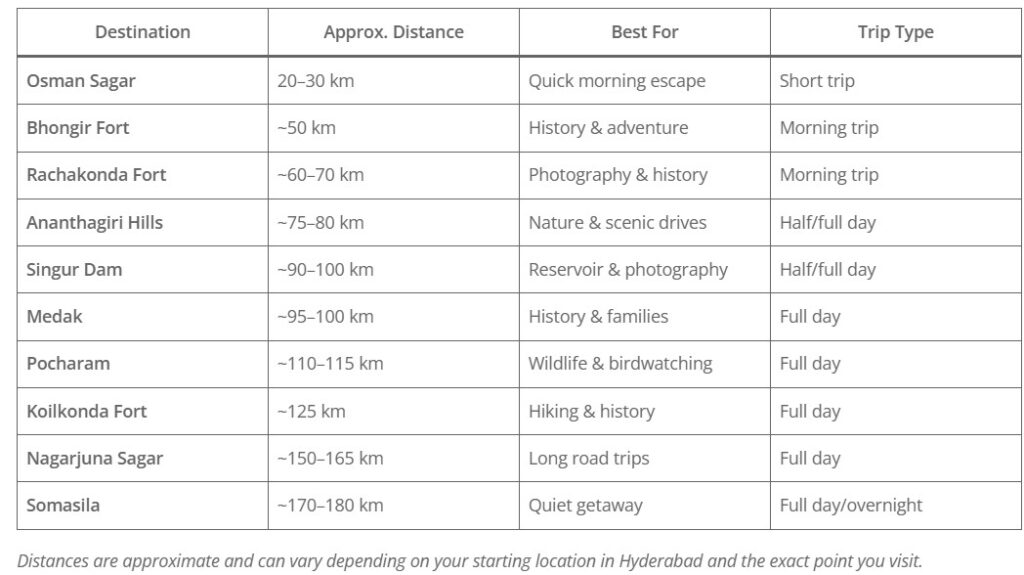
Here’s a quick comparison to help you choose:
Quick Recommendations
For the shortest drive: Osman Sagar
For a fort and adventure: Bhongir Fort
For nature and greenery: Ananthagiri Hills
For reservoir views: Singur Dam
For history and sightseeing: Medak
For wildlife and birdwatching: Pocharam Wildlife Sanctuary
For a longer road trip: Nagarjuna Sagar
For a quieter long-distance escape: Somasila
For hiking and history: Koilkonda Fort or Rachakonda Fort
Planning tip: If sunrise is your priority, choose your destination based on the time required to reach the actual viewing area—not just the driving distance from Hyderabad.
Which Sunrise Drive Near Hyderabad Is Best for You?
The best destination depends on how much time you have, who you’re travelling with, and whether you want a peaceful drive, a hike, photography, history, or a full-day outing.
Best for Couples
For couples looking for a relaxed early-morning outing, Ananthagiri Hills, Osman Sagar, and Singur Dam are good options to consider.
Ananthagiri Hills offers a greener, more scenic road-trip atmosphere, while Osman Sagar is convenient for a shorter outing. Singur works better if you want to spend more time on the road and enjoy reservoir surroundings.
Best for Families
If you’re planning a family road trip, Osman Sagar, Medak, Ananthagiri Hills, and Singur Dam can be considered depending on the age and mobility of everyone travelling.
Medak is particularly useful for families who want to combine a road trip with sightseeing and historical attractions.
Best for Photography
For landscape and travel photography, consider Ananthagiri Hills, Bhongir Fort, Rachakonda Fort, Singur Dam, and Pocharam Wildlife Sanctuary.
Each offers a different setting, from hills and forests to rocky landscapes, reservoirs, and wildlife habitats.
Best for Adventure
If you want more than simply driving to a viewpoint, Bhongir Fort, Koilkonda Fort, and Rachakonda Fort offer a combination of road travel, walking, climbing, and historical exploration.
Wear suitable footwear and allow enough time to reach the fort or viewpoint safely.
Best for a Short Morning Drive
Don’t want to spend half your day travelling?
Osman Sagar is the most convenient choice from this list because of its proximity to Hyderabad.
Bhongir Fort and Rachakonda Fort can also work for travellers looking for a relatively short drive combined with some exploration.
Best for a Full Day Road Trip
If you enjoy spending the entire day exploring, consider Medak, Pocharam, Koilkonda Fort, or Nagarjuna Sagar.
These destinations offer more opportunities to combine the early-morning drive with sightseeing, nature, history, or other local attractions.
Best for a Long Scenic Drive
For travellers who genuinely enjoy being behind the wheel, Nagarjuna Sagar and Somasila are better suited to longer road trips.
Because of the distance, plan fuel stops, breaks, weather conditions, and return travel carefully. If sunrise is the main objective, consider staying nearby the previous night instead of driving several hours before dawn.
How Early Should You Leave Hyderabad for a Sunrise Drive?
The ideal departure time depends on your destination, starting point in Hyderabad, road conditions, and whether you need to walk or climb before reaching the viewing area.
A common mistake is planning to reach the destination exactly at sunrise. Instead, give yourself enough time to park, walk, find a suitable location, and deal with unexpected delays.
For Nearby Destinations
For places such as Osman Sagar and Bhongir Fort, you can generally plan your departure based on the expected driving time and aim to arrive well before sunrise.
Allow an additional 20–30 minutes of buffer whenever possible.
For Medium Distance Destinations
For destinations such as Ananthagiri Hills, Rachakonda Fort, Singur Dam, and Medak, allow additional time for traffic, route conditions, and stops.
Starting 60–90 minutes or more before the expected arrival time can give you a more relaxed journey.
For Longer Road Trips
For destinations such as Koilkonda Fort, Pocharam, Nagarjuna Sagar, and Somasila, sunrise planning requires more preparation.
If the destination is several hours away, consider:
Starting much earlier
Checking the route the previous night
Identifying fuel stations along the way
Taking breaks during the journey
Staying nearby the previous night if necessary
Check the Sunrise Time Before You Leave
Sunrise time changes throughout the year, so don’t rely on a fixed departure time such as 5:00 AM.
Check the actual sunrise time for your travel date, then work backwards based on your estimated driving time and the additional time needed to reach your intended viewing area.
Don’t Rush to Catch the Sunrise
A sunrise is not worth unsafe driving.
If you’re running late, maintain a safe speed rather than trying to make up time on an empty-looking highway. Reaching a few minutes after sunrise is far better than taking unnecessary risks on the road.
Planning tip: Aim to reach the destination or viewpoint at least 20–30 minutes before sunrise whenever practical. This gives you time to park, walk, settle down, and enjoy the changing sky.
What to Carry for a Sunrise Road Trip from Hyderabad
Early-morning drives are usually more enjoyable when you prepare a few essentials the night before. Depending on the destination, you may be driving for several hours, walking to a viewpoint, or spending time outdoors after sunrise.
Road Trip Essentials
Drinking water
Light snacks
Fully charged mobile phone
Power bank
Phone holder
Offline maps or downloaded directions
Driving licence and vehicle documents
Basic first-aid supplies
For Forts and Hiking Destinations
If you’re visiting places such as Bhongir Fort, Koilkonda Fort, or Rachakonda Fort, add:
Comfortable walking shoes with good grip
A small backpack
Extra drinking water
Light clothing suitable for walking
A flashlight if you expect to walk before daylight
For Photography
If you’re planning a sunrise photography trip, consider carrying:
Camera or smartphone
Extra battery or power bank
Tripod, if permitted
Lens cleaning cloth
Extra storage space for photographs
For Cooler Mornings
Early mornings can feel cooler than expected, particularly around elevated or open areas.
Carry a light jacket or extra layer that you can remove later as temperatures rise.
Before Leaving Home
A quick check the night before can save you from unnecessary delays:
Check the weather forecast
Check your route
Confirm destination access timings
Check fuel level
Charge your phone
Download offline directions if needed
Check tyre condition
Make sure the vehicle lights are working
A little preparation means you can spend more time enjoying the sunrise and less time dealing with avoidable problems.
Tips for a Safe Sunrise Drive from Hyderabad
Driving before sunrise can be enjoyable, but visibility is lower and some rural roads may have pedestrians, cyclists, animals, or vehicles without adequate lighting. A few precautions can make the journey much safer.
1. Check the Weather Before Leaving
Fog, heavy rain, or poor visibility can make an early-morning drive more difficult. Check the forecast and reconsider the trip if conditions are unsafe.
2. Check Your Vehicle
Before starting, make sure your:
Headlights are working
Brake lights are working
Tyres have adequate pressure
Fuel level is sufficient
Windscreen is clean
Wipers are working properly
3. Don’t Speed Because the Roads Are Empty
An empty highway can create a false sense of safety. Maintain a reasonable speed and stay alert for unexpected obstacles, animals, pedestrians, and two-wheelers.
4. Be Extra Careful on Rural Roads
Some roads outside Hyderabad may have limited street lighting. Reduce speed when visibility is poor and use your headlights appropriately.
5. Take Breaks on Long Drives
If you’re travelling to destinations such as Nagarjuna Sagar, Somasila, or Koilkonda Fort, don’t try to complete a long journey without rest.
Stop at safe locations whenever you feel tired.
6. Don’t Use Your Phone While Driving
Use a phone holder for navigation and set your route before starting. If you need to check directions or make a call, stop somewhere safe.
7. Watch for Wildlife and Livestock
Rural and forest areas can have animals crossing roads, particularly during early hours. Slow down when travelling through areas where wildlife or livestock may be present.
8. Follow Local Access Rules
Forts, forests, wildlife sanctuaries, reservoirs, and other attractions may have specific opening times or restricted areas.
Check current access information before planning a pre-sunrise visit.
9. Respect the Destination
Keep these places clean and avoid disturbing wildlife or local communities.
Don’t litter
Don’t damage historical structures
Don’t enter restricted areas
Avoid loud music in natural areas
Follow instructions from local authorities
10. Don’t Sacrifice Safety for Sunrise
If you’re running late, don’t speed to reach the destination before sunrise.
The sunrise can be missed. Safe driving shouldn’t be.
Choosing the Right Car for Your Sunrise Road Trip
The vehicle you choose can make a noticeable difference, especially when your trip starts before dawn or involves several hours of driving.
The best option depends on your route, number of passengers, luggage, and how long you plan to stay on the road.
Hatchbacks and Sedans
For couples or small groups travelling to destinations such as Osman Sagar, Bhongir Fort, Rachakonda Fort, or Ananthagiri Hills, a hatchback or sedan can be a practical choice.
They are generally suitable for shorter road trips where you don’t need a large amount of luggage space.
SUVs
An SUV can be a better option when you’re travelling with family or friends and want additional cabin and luggage space.
For longer routes such as Nagarjuna Sagar, Somasila, or Koilkonda Fort, choosing a comfortable vehicle can make several hours on the road easier.
Chauffeur Driven Cars
If you want to enjoy the scenery without being responsible for the early-morning drive, a chauffeur driven car can be an alternative.
This can be particularly useful for families, senior travellers, or groups who prefer not to drive before sunrise.
Tempo Travellers for Groups
Planning a sunrise road trip with a larger group?
A Tempo Traveller can be useful when several people want to travel together rather than taking multiple cars.
It can be a practical option for family outings, group trips, photography groups, and weekend excursions.
Why Choose YoDrives for Your Sunrise Road Trip?
An early start is much easier when you have a vehicle that suits your journey.
With YoDrives, travellers can choose from different rental options depending on their route and group size.
YoDrives offers options including:
Self-drive cars
Chauffeur-driven cars
Hatchbacks
Sedans
SUVs
Tempo Travellers for groups
Vehicles for short and long-distance trips
Flexible rental durations
Whether you’re planning a quick drive to Osman Sagar, a weekend trip to Ananthagiri Hills, or a longer journey towards Nagarjuna Sagar, you can select a vehicle based on your travel requirements.
Plan Your Sunrise Drive with YoDrives
Choose your destination, decide how many people are travelling, select a suitable vehicle, and plan your departure around the actual sunrise time.
Looking for a self-drive car rental in Hyderabad for your next road trip? Explore YoDrives and choose a vehicle that fits your journey.
Customer Testimonials
Frequently Asked Questions About Sunrise Drives Near Hyderabad
1. What are the best sunrise drives near Hyderabad?
Some popular options include Ananthagiri Hills, Bhongir Fort, Osman Sagar, Singur Dam, Medak, Rachakonda Fort, Pocharam Wildlife Sanctuary, Koilkonda Fort, Nagarjuna Sagar, and Somasila. The best choice depends on your travel time, interests, and whether you’re looking for a short drive or a full-day road trip.
2. Which is the best sunrise destination near Hyderabad for a short trip?
Osman Sagar is one of the most convenient choices because it is relatively close to Hyderabad. Bhongir Fort can also work for travellers who want a short drive combined with a fort visit and climb.
3. How early should I leave Hyderabad for a sunrise road trip?
It depends on the destination and your starting point. For nearby locations, plan your departure around the expected driving time and aim to arrive 20–30 minutes before sunrise. For longer destinations, leave much earlier and allow additional time for breaks, parking, walking, and unexpected delays.
4. Which sunrise places near Hyderabad are good for couples?
Ananthagiri Hills, Osman Sagar, and Singur Dam can be good options for couples looking for a relaxed morning drive. Your choice will depend on whether you prefer a short outing or a longer road trip.
5. Which sunrise destinations near Hyderabad are suitable for families?
Osman Sagar, Ananthagiri Hills, Medak, and Singur Dam can work well for family outings. Fort destinations such as Bhongir and Koilkonda involve climbing or uneven terrain, so consider the mobility and comfort of everyone travelling.
6. What are the best scenic drives near Hyderabad?
Ananthagiri Hills, Singur Dam, Rachakonda Fort, Bhongir Fort, and the routes towards Nagarjuna Sagar offer different types of scenery, including hills, forests, rocky landscapes, reservoirs, and countryside roads.
7. Can I take a self-drive car for a sunrise road trip from Hyderabad?
Yes. A self-drive rental can be a convenient option when you want flexibility over your departure time, route, stops, and return schedule. Choose a vehicle based on your group size, luggage, and distance.
8. What type of car is best for a sunrise road trip?
A hatchback or sedan can work well for couples and small groups travelling shorter distances. An SUV can provide additional space and comfort for longer journeys or families, while a Tempo Traveller can be suitable for larger groups.
9. Can I complete a sunrise road trip as a one-day trip from Hyderabad?
Yes. Destinations such as Bhongir Fort, Ananthagiri Hills, Singur Dam, Medak, and Pocharam can be considered for one-day trips depending on your itinerary. Longer destinations such as Somasila may be better suited to a more relaxed itinerary or overnight stay.
10. Is it safe to drive before sunrise?
It can be, provided you drive responsibly and prepare in advance. Check the weather, vehicle condition, route, and fuel before leaving. Drive at a safe speed and watch carefully for pedestrians, animals, cyclists, and other vehicles on poorly lit roads.
11. What should I carry for an early morning road trip?
Carry drinking water, light snacks, a fully charged phone, power bank, navigation, vehicle documents, comfortable footwear, and basic first-aid supplies. If you’re travelling to a fort or hiking location, appropriate shoes are particularly important.
12. Why choose YoDrives for a sunrise road trip?
YoDrives provides self drive and chauffeur driven rental options, including hatchbacks, sedans, SUVs, and group vehicles. Travellers can choose an option based on their route, group size, comfort requirements, and trip duration
Final Thoughts
From the greenery of Ananthagiri Hills to the historic views of Bhongir Fort and the peaceful waters of Osman Sagar and Singur Dam, Hyderabad has plenty of destinations for an early morning road trip.Explore YoDrives for self-drive and chauffeur-driven car rentals in Hyderabad and choose the right vehicle for your next road trip.
Learn about the most common traffic violations in Hyderabad, estimated traffic fines, Telangana traffic rules, e-Challan information, and practical tips to avoid penalties and drive safely.
Introduction
Driving in Hyderabad has become more convenient with better roads, flyovers, and expressways, but it also requires every motorist to follow traffic rules responsibly. Whether you’re commuting through Hitech City, Gachibowli, Banjara Hills, Kukatpally, Secunderabad, or driving on the Outer Ring Road (ORR), even a small traffic violation can lead to heavy fines, legal action, licence-related issues, or, more importantly, serious accidents.
Many drivers unknowingly commit common traffic violations in Hyderabad, such as overspeeding, jumping traffic signals, using a mobile phone while driving, illegal parking, or driving without valid documents. While these mistakes may seem minor, they can result in expensive e-Challans and compromise the safety of everyone on the road.
Hyderabad motorists should stay updated with the latest traffic regulations issued by the Hyderabad Traffic Police to ensure safe and responsible driving.
In this guide, we’ll cover the most common traffic violations in Hyderabad, their estimated penalties, and practical tips to help you drive responsibly and avoid costly fines.
What You’ll Learn
By the end of this guide, you’ll know:
The most common traffic violations in Hyderabad
Estimated traffic fines and penalties
How to avoid expensive e-Challans
Essential documents every driver should carry
Safe driving practices for Hyderabad roads
What to do if you receive an incorrect traffic challan
1. Overspeeding
Overspeeding is one of the most common traffic violations in Hyderabad and remains a major cause of road accidents. Drivers often exceed speed limits on the Outer Ring Road (ORR), PV Narasimha Rao Expressway, flyovers, and wide city roads, assuming that open roads allow faster driving. However, speed limits are carefully determined based on traffic flow, road conditions, pedestrian movement, and accident risks.
Why It Happens
Drivers often overspeed because they:
Are running late
Feel confident on empty roads
Ignore posted speed limits
Attempt to overtake aggressively
Estimated Fine
Hyderabad Traffic Police currently lists an indicative penalty of ₹1,400 for overspeeding. Actual penalties may vary depending on the vehicle type, location, and applicable government regulations.
If you receive a traffic challan, you can easily verify and pay it online through the official Telangana eChallan Portal.
Why It’s Dangerous
Overspeeding significantly reduces your reaction time and increases the severity of accidents. It becomes even more dangerous when you encounter:
Sudden braking by another vehicle
Pedestrians crossing unexpectedly
Waterlogged roads during monsoon
Potholes
Road diversions
Poor visibility at night
How to Avoid It
Follow speed limit boards.
Maintain a safe following distance.
Slow down during rain and heavy traffic.
Never rush to save a few minutes at the cost of safety.
2. Using a Mobile Phone While Driving
Using a mobile phone while driving is another common traffic violation in Hyderabad that frequently leads to accidents. Whether you’re replying to messages, answering calls, changing music, checking social media, or recording videos, even a few seconds of distraction can have serious consequences.
Estimated Fine
The Hyderabad Traffic Police currently lists an indicative penalty of ₹1,000 for using a mobile phone while driving.
Why It’s Dangerous
Mobile phone usage creates three major distractions:
Visual: Eyes move away from the road.
Manual: One or both hands leave the steering wheel.
Mental: Attention shifts away from surrounding traffic.
Safety Tips
Before starting your journey:
Set your GPS destination.
Select your playlist.
Mount your phone securely.
Stop safely before answering important calls.
Never assume it’s safe to use your phone while waiting at a traffic signal.
3. Jumping a Red Signal
Traffic signals are designed to regulate vehicle movement and protect pedestrians. Ignoring a red light is one of the most dangerous traffic violations in Hyderabad because it increases the risk of high-speed collisions at busy intersections.
Estimated Fine
The Hyderabad Traffic Police currently lists an indicative penalty of ₹1,000 for signal jumping.
Common Reasons
Drivers often jump signals because they:
Try to beat the yellow light.
Become impatient during long waits.
Follow another vehicle through the intersection.
Assume the junction is empty.
How to Avoid It
Slow down when approaching traffic lights.
Stop behind the stop line.
Never accelerate when the signal turns yellow.
Stay alert for pedestrians and emergency vehicles.
Saving a few seconds is never worth risking an accident or receiving an e-Challan.
4. Wrong Side Driving
Wrong-side driving remains one of the most common traffic violations in Hyderabad, particularly near U-turns, service roads, markets, fuel stations, and residential areas. Drivers often choose the wrong side of the road to save a few minutes, but this dangerous habit significantly increases the risk of head-on collisions.
Estimated Fine
Hyderabad Traffic Police currently lists an indicative penalty of ₹1,100 for wrong-side driving.
Why It’s Dangerous
Wrong-side driving becomes especially risky:
At night
During heavy rainfall
Near blind curves
On flyovers
On high-speed roads
Around parked vehicles
Best Practice
Always use designated U-turns and follow the correct lane, even if it takes a little longer.
5. Drunk Driving
Driving under the influence of alcohol or intoxicating substances is one of the most serious traffic violations in Hyderabad. Alcohol affects judgement, reaction time, concentration, vision, and coordination, making it unsafe to operate any vehicle.
Unlike many other traffic offences, drunk driving can lead to court proceedings, substantial fines, licence suspension, imprisonment, or other legal consequences depending on the severity of the offence.
How to Stay Safe
If you’re attending a:
Party
Wedding
Celebration
Corporate event
Social gathering
Plan your journey in advance by:
Booking a cab.
Choosing a designated driver.
Staying overnight if required.
Asking a sober friend or family member to drive.
Never rely on coffee, food, or a short rest to eliminate the effects of alcohol before driving.
6. Driving Without a Valid Driving Licence
Driving without a valid licence is one of the most common traffic violations in Hyderabad and can lead to significant legal consequences. A valid driving licence confirms that you are legally authorised to drive a particular category of vehicle on public roads.
Whether you’re driving your own vehicle or a rental car, always ensure your licence is valid before starting your journey.
Why It Matters
Driving without a valid licence may result in:
Traffic fines
Legal action
Insurance claim complications
Additional penalties if involved in an accident
Before Driving, Check That:
Your driving licence has not expired.
The licence matches the vehicle category.
Your personal details are correct.
You comply with any licence restrictions.
Vehicle owners should also avoid allowing underage or unlicensed individuals to drive, as this may attract separate penalties.
7. Driving Without Valid Insurance
Motor insurance is mandatory and protects you against financial liabilities arising from accidents involving other vehicles, property, or individuals. Driving without valid insurance is another common traffic violation in Hyderabad that many motorists overlook until they are stopped during a traffic inspection.
Why Insurance Is Important
Valid insurance helps protect you from:
Third-party liability
Accident-related expenses
Legal complications
Unexpected financial losses
Before Every Journey
Make sure your insurance policy:
Is active
Covers your vehicle
Has not expired
If you’re driving a rental car, understand the rental company’s insurance policy, accident reporting process, and liability conditions before beginning your trip.
8. Driving Without Registration or Required Documents
Every vehicle on Hyderabad roads must have valid registration and mandatory documents. Driving without these documents is one of the most common traffic violations in Hyderabad and can result in heavy penalties.
Estimated Fine
Hyderabad Traffic Police currently lists an indicative penalty of ₹2,000 for driving without registration. Separate penalties may also apply for missing Pollution Under Control (PUC) certificates and irregular number plates.
Essential Documents Every Driver Should Carry
Before leaving home, verify that you have:
Driving Licence
Registration Certificate (RC)
Motor Insurance
Pollution Under Control (PUC) Certificate
Vehicle Permit (if applicable)
Fitness Certificate (where required)
Digital documents available through authorised government apps are generally accepted, provided they are valid and accessible.
9. Not Wearing a Helmet
Not wearing a helmet remains one of the most common traffic violations in Hyderabad, especially among two-wheeler riders travelling short distances. However, many serious accidents occur close to home, making helmets essential for every journey.
Why Helmets Save Lives
A properly fitted helmet significantly reduces the risk of severe head injuries during accidents.
Common Mistakes
Avoid:
Wearing an unfastened helmet.
Using damaged or poor-quality helmets.
Carrying the helmet instead of wearing it.
Removing the helmet during short trips.
Both the rider and pillion passenger should always wear ISI certified helmets.
10. Not Wearing a Seat Belt
Many drivers assume seat belts are necessary only for highway travel. In reality, not wearing a seat belt is one of the most common traffic violations in Hyderabad, and accidents can occur even during low-speed city driving.
Seat belts protect not only the driver but also front and rear passengers by reducing the impact during sudden braking or collisions.
Before You Start Driving
Always ensure:
Every passenger wears a seat belt.
Children use an appropriate child restraint.
Seat belts are properly fastened.
The shoulder belt rests correctly across the chest.
Remember, airbags are designed to work alongside seat belts not replace them.
Quick Safety Checklist Before Every Drive
Before starting your vehicle, take one minute to confirm:
✅ Carry your Driving Licence
✅ Registration Certificate (RC)
✅ Motor Insurance
✅ PUC Certificate
✅ Wear your seat belt or helmet
✅ Set navigation before driving
✅ Keep your mobile phone away while driving
✅ Follow speed limits
✅ Check mirrors and blind spots
✅ Drive patiently and obey traffic signals
These simple habits can help you avoid the most common traffic violations in Hyderabad while making every journey safer for you and others on the road.
Frequently Asked Questions
Q1. What is the most common traffic violation in Hyderabad?
Overspeeding, signal jumping, and using a mobile phone while driving are among the most common traffic violations in Hyderabad.
Q2. How can I check my Hyderabad traffic challan?
You can check your e-Challan on the Telangana Traffic Police portal using your vehicle number.
Q3. What documents should I carry while driving in Hyderabad?
Carry your Driving Licence, RC, Insurance, and Pollution Under Control (PUC) certificate.
Q4. What happens if I don’t pay my Hyderabad traffic challan?
Unpaid challans may lead to additional legal action or issues during vehicle verification and renewal.
Q5. How can I avoid traffic violations in Hyderabad?
Follow speed limits, obey traffic signals, wear seat belts or helmets, avoid using mobile phones while driving, and always carry valid documents.
6. Are digital driving documents valid in Hyderabad?
Yes, digital documents available through authorized government apps are generally accepted by traffic police.
7. Is wearing a helmet compulsory for pillion riders?
Yes, both the rider and pillion rider must wear an ISI-certified helmet.
8. Can I use my mobile phone while waiting at a traffic signal?
No. Using a mobile phone while driving or waiting at a signal can still attract a traffic fine.
9. Is seat belt compulsory for all passengers?
Yes, wearing a seat belt is mandatory for the driver and all passengers where applicable.
10. What should I do if I receive an incorrect traffic challan?
Verify the challan details online and contact the Telangana Traffic Police to raise a dispute if the challan was issued incorrectly.
Conclusion
Understanding the common traffic violations in Hyderabad helps you stay safe, avoid fines, and become a responsible driver. Follow traffic rules, carry valid documents, and drive patiently to make every journey safe.
Drive Safe with YoDrives
Need a reliable ride? YoDrives offers self-drive cars, chauffeur-driven cars, tempo travellers, and buses across Hyderabad.
Discover the best cars for monsoon road trips in India. Compare SUVs, sedans, MPVs, top destinations from Hyderabad, safety tips, and choose the perfect vehicle for a memorable rainy season adventure.\
Best Cars for Monsoon Road Trips in India
Planning a monsoon road trip is exciting, but choosing the best car for a monsoon road trip is just as important as selecting your destination. Rain transforms India’s landscapes into lush green valleys, mist-covered hills, roaring waterfalls, and scenic highways, making it one of the most beautiful seasons for travelling. However, it also brings slippery roads, waterlogged streets, potholes, reduced visibility, and challenging mountain routes.
Whether you’re travelling with family, friends, or your partner, choosing one of the Best Cars for Monsoon Road Trips ensures a safer, smoother, and more enjoyable journey. A vehicle with good ground clearance, strong braking performance, reliable tyres, and comfortable seating helps you travel confidently and comfortably from start to finish.
In this guide, we’ll help you discover the Best Cars for Monsoon Road Trips, compare SUVs and sedans, explore the top rainy-season destinations from Hyderabad, and share practical driving tips to help you enjoy a safe and comfortable monsoon journey.
Why Choosing the Right Car Matters During Monsoon
While many travellers focus only on their destination, choosing one of the Best Cars for Monsoon Road Trips is equally important. Monsoon roads often bring challenges such as heavy rain, slippery surfaces, and reduced visibility. A reliable, well-maintained car with the right features ensures a safer, smoother, and more comfortable journey throughout your trip.
The right vehicle offers several advantages:
Better grip on wet roads
Higher ground clearance for waterlogged areas
Improved visibility during rainfall
Comfortable seating for long-distance travel
Spacious luggage capacity
Enhanced safety features like ABS and Electronic Stability Control
Better confidence on ghat roads and hill station routes
Whether you’re heading to Ooty, Coorg, Munnar, Wayanad, or Araku Valley, choosing one of the Best Cars for Monsoon Road Trips ensures a safer, more comfortable, and enjoyable journey, allowing you to make the most of every mile.
What Makes a Car Ideal for Monsoon Road Trips?
Before selecting one of the Best Cars for Monsoon Road Trips, consider these essential features to ensure a safe, comfortable, and hassle-free journey.
High Ground Clearance
Heavy rain often causes waterlogging and hidden potholes. Vehicles with higher ground clearance reduce the chances of underbody damage and provide better confidence on rough roads.
Best suited for:
Hill stations
Rural roads
Forest routes
Waterlogged city roads
Excellent Tyre Grip
Tyres are the only contact between your car and the road. Good tread depth and quality tyres significantly improve traction while reducing the risk of skidding during heavy rain.
Reliable Braking System
Modern braking technologies improve vehicle control during emergencies.
Look for features such as:
ABS (Anti-lock Braking System)
Electronic Brakeforce Distribution (EBD)
Electronic Stability Control (ESC)
Hill Hold Assist
These systems provide additional confidence while driving on slippery roads.
Comfortable Cabin
Monsoon road trips often involve several hours of driving. Comfortable seats, automatic climate control, low cabin noise, and good suspension make long journeys much more enjoyable.
Spacious Boot Space
Families usually carry luggage, umbrellas, rain gear, snacks, and photography equipment. A larger boot keeps everything organised while ensuring passenger comfort.
Best Cars for Monsoon Road Trips in India
Here are some of the most reliable vehicles for rainy-season travel.
1. Mahindra XUV700
The Mahindra XUV700 is one of the best SUVs for monsoon road trips. It combines excellent safety, premium comfort, strong performance, and modern technology, making it ideal for long-distance travel.
Best For
Family vacations
Hill stations
Long highway drives
Kerala road trips
Coorg
Munnar
Why Choose It?
Excellent ground clearance
Powerful petrol and diesel engines
Spacious cabin
Advanced ADAS safety features
Comfortable suspension
Large luggage compartment
Ideal Rating: ⭐⭐⭐⭐⭐
2. Tata Harrier
The Tata Harrier offers impressive road stability and a rugged design, making it a dependable choice during the rainy season. It handles wet highways and uneven roads confidently while providing premium comfort.
Best For
Wayanad
Coorg
Long-distance road trips
Families
Highlights
Strong build quality
Excellent ride comfort
High ground clearance
Premium interiors
Stable highway performance
Ideal Rating: ⭐⭐⭐⭐⭐
3. Hyundai Creta
The Hyundai Creta continues to be one of India’s most popular SUVs because of its refined driving experience, excellent comfort, and balanced performance.
Best For
Weekend getaways
Couples
Families
Ooty
Chikmagalur
Araku Valley
Advantages
Smooth handling
Comfortable seats
Reliable performance
Excellent fuel efficiency
Easy city and highway driving
Ideal Rating: ⭐⭐⭐⭐☆
4. Kia Seltos
The Kia Seltos combines premium styling with practical performance. It is an excellent option for travellers looking for a feature-rich SUV capable of handling both highways and moderate hill roads.
Best For
Couples
Weekend trips
Highway touring
Family vacations
Highlights
Comfortable interiors
Large boot space
Good ride quality
Modern infotainment system
Confident wet-road handling
Ideal Rating: ⭐⭐⭐⭐
5. Toyota Innova Hycross
Travelling with a large family? The Toyota Innova Hycross is among the most practical vehicles for monsoon road trips. Its spacious cabin, excellent reliability, and comfortable ride make it perfect for long-distance travel.
Best For
Group travel
Family vacations
Kerala circuit
Multi-city road trips
Advantages
Spacious three-row seating
Smooth highway performance
Large luggage capacity
Reliable engine
Comfortable suspension
Ideal Rating: ⭐⭐⭐⭐⭐
6. Mahindra Scorpio N
For travellers seeking adventure, the Scorpio N is built to tackle rough roads, mountain climbs, and challenging weather conditions.
Best For
Offbeat destinations
Mountain roads
Heavy rainfall
Adventure road trips
Why Travellers Love It
Rugged build quality
Commanding driving position
High ground clearance
Excellent road presence
Strong performance
Ideal Rating: ⭐⭐⭐⭐⭐
Quick Comparison of the Best Cars for Monsoon Road Trips
Which Car Should You Choose?
Choosing the best car for a monsoon road trip depends on your travel style and destination.
For families: Toyota Innova Hycross or Mahindra XUV700
For couples: Hyundai Creta or Kia Seltos
For adventure lovers: Mahindra Scorpio N
For long distance comfort: Tata Harrier
For mixed city and highway driving: Hyundai Creta
Best Monsoon Road Trip Destinations from Hyderabad
One of Hyderabad’s biggest advantages is its easy access to scenic hill stations, waterfalls, coffee plantations, and lush green valleys. Here are some of the best monsoon road trips and the ideal cars for each destination.
1. Ooty
Distance: 850–900 km
Ooty is famous for its tea gardens, misty hills, and pleasant weather during the monsoon. The winding ghat roads make an SUV the ideal choice.
Top Attractions: Ooty Lake, Doddabetta Peak, Botanical Garden, Pykara Falls
Best Cars: Hyundai Creta, Kia Seltos, Tata Harrier, Mahindra XUV700
2. Coorg
Distance: 820–850 km
Coorg offers coffee plantations, waterfalls, and forest roads that become even more scenic during the rainy season.
Top Attractions: Abbey Falls, Raja’s Seat, Dubare Elephant Camp
Best Cars: Tata Harrier, Mahindra Scorpio N, Mahindra XUV700
3. Munnar
Distance: 1,150 km
Munnar is known for endless tea plantations, mist-covered mountains, and breathtaking viewpoints.
Top Attractions: Eravikulam National Park, Mattupetty Dam, Echo Point
Best Cars: Mahindra XUV700, Toyota Innova Hycross, Hyundai Creta
4. Wayanad
Distance: 950–1,000 km
A perfect destination for nature lovers, Wayanad features waterfalls, wildlife, and lush forests.
Top Attractions: Edakkal Caves, Soochipara Falls, Pookode Lake
Best Cars: Tata Harrier, Toyota Fortuner, Hyundai Creta
5. Chikmagalur
Distance: 650–700 km
Known for coffee estates and mountain views, Chikmagalur is a great weekend road trip.
Top Attractions: Mullayanagiri Peak, Hebbe Falls, Coffee Museum
Best Cars: Hyundai Creta, Kia Seltos, Tata Harrier
6. Araku Valley
Distance: 700 km
Araku Valley is one of the closest monsoon getaways from Hyderabad, offering waterfalls, caves, and coffee plantations.
Top Attractions: Borra Caves, Katiki Falls, Tribal Museum
Best Cars: Hyundai Creta, Kia Seltos, Honda City
7. Kerala Circuit
Distance: 1,100–1,250 km
A week-long road trip covering Kochi, Munnar, Thekkady, and Alleppey offers one of India’s best monsoon travel experiences.
Best Cars: Toyota Innova Hycross, Mahindra XUV700, Tata Harrier
Best Car for Each Destination
Destination
Recommended Vehicle
Ooty
Hyundai Creta, Kia Seltos
Coorg
Tata Harrier, Scorpio N
Munnar
XUV700, Innova Hycross
Wayanad
Harrier, Fortuner
Chikmagalur
Creta, Seltos
Araku Valley
Honda City, Grand Vitara
Kerala Circuit
XUV700, Innova Hycross
SUV vs Sedan: Which Should You Choose?
Choose an SUV for Ooty, Munnar, Coorg, Wayanad, Chikmagalur, and the Kerala Circuit, where higher ground clearance and better stability are helpful on hilly or rain-soaked roads.
A sedan is suitable for Araku Valley and highway focused trips with well-maintained roads, offering good comfort and fuel efficiency.
Why Choose YoDrives for Your Monsoon Road Trip?
Whether you’re planning a weekend getaway or a week-long vacation, YoDrives offers reliable vehicles for every type of traveller. From self-drive cars to chauffeur-driven rentals, you’ll find hatchbacks, sedans, SUVs, luxury cars, MPVs, Tempo Travellers, and buses all maintained for a comfortable and hassle-free journey.
Why Travellers Choose YoDrives
Well-maintained and sanitized vehicles
Self-drive and chauffeur-driven options
Wide range of SUVs, sedans, and luxury cars
Flexible rental packages
Transparent pricing with no hidden charges
24/7 customer support
Ideal for family trips, business travel, airport transfers, and outstation journeys
Customer Testimonial
Frequently Asked Questions (FAQs)
1. Which is the best car for monsoon road trips in India?
SUVs like the Mahindra XUV700, Tata Harrier, Hyundai Creta, and Kia Seltos are among the best choices due to their ground clearance, stability, and safety features.
2. Are SUVs better than sedans during the monsoon?
Yes. SUVs generally offer better ground clearance, improved visibility, and greater confidence on wet roads and hill station routes.
3. Which are the best monsoon road trip destinations from Hyderabad?
Popular choices include Ooty, Coorg, Munnar, Wayanad, Chikmagalur, Araku Valley, and the Kerala circuit.
4. Is it safe to drive to hill stations during the rainy season?
Yes, provided you drive carefully, follow weather updates, and avoid travelling during heavy rainfall or landslide warnings.
5. What should I check before starting a monsoon road trip?
Inspect tyres, brakes, windshield wipers, lights, engine fluids, battery, and ensure all vehicle documents are valid.
6. Does YoDrives offer self drive cars for outstation trips?
Yes. YoDrives provides self-drive cars for outstation travel, allowing you to explore destinations at your own pace.
7. Can I book chauffeur driven cars with YoDrives?
Yes. Chauffeur-driven cars are available for family vacations, airport transfers, business travel, sightseeing, and long-distance journeys.
8. Which YoDrives vehicle is best for a family road trip?
The Toyota Innova Hycross, Mahindra XUV700, and Tata Harrier are excellent choices for families because of their spacious interiors and comfortable ride quality.
9. Why should I rent a car instead of using my own vehicle?
Renting allows you to choose the right vehicle for your trip without worrying about maintenance, servicing, or adding wear and tear to your personal car.
Conclusion
A monsoon road trip is one of the best ways to experience India’s scenic landscapes, from misty hill stations and coffee plantations to waterfalls and lush green valleys. Choosing the best car for monsoon road trips ensures a safer, smoother, and more comfortable journey, especially on wet roads and winding mountain routes.
Whether you’re planning a quick weekend escape to Araku Valley or a week-long adventure through Kerala, selecting the right vehicle can make all the difference.
Ready for Your Next Monsoon Adventure?
Book your ideal self-drive or chauffeur-driven vehicle with YoDrives and travel with confidence this rainy season.
Discover the roads to avoid during heavy rain in Hyderabad, monsoon driving tips, safer routes, and why YoDrives is your trusted travel partner.
Hyderabad’s monsoon season brings cooler weather, lush green surroundings, and welcome relief from the summer heat. However, it also creates one of the biggest challenges for daily commuters and travelers waterlogged roads, heavy traffic congestion, and unexpected travel delays.
A sudden downpour can quickly turn a 20-minute drive into an hour-long journey. Flooded stretches, reduced visibility, overflowing drains, hidden potholes, and slow-moving traffic can make driving stressful, especially during peak office hours. That’s why knowing the roads to avoid during heavy rain in Hyderabad is essential for planning a safer and more efficient journey.
Whether you’re travelling to the airport, commuting to work in Hyderabad’s IT corridor, attending an important meeting, or heading out for a weekend getaway, understanding the roads to avoid during heavy rain in Hyderabad can help you avoid traffic bottlenecks, choose better routes, and reach your destination safely.
In this guide, we’ll highlight the roads to avoid during heavy rain in Hyderabad, share practical monsoon driving tips, recommend useful travel apps, and explain how choosing a reliable vehicle from YoDrives can make your rainy-day journeys safer and more comfortable.
Roads that frequently experience waterlogging
Traffic-prone areas during monsoon
Smart driving tips
Alternative routes when available
Emergency monsoon checklist
Why choosing a well-maintained YoDrives rental vehicle makes rainy-day travel easier
Why You Should Know the Roads to Avoid During Heavy Rain in Hyderabad
If you’re planning to travel during the monsoon, knowing the roads to avoid during heavy rain in Hyderabad can help you steer clear of areas that frequently experience waterlogging, heavy traffic, and travel delays.
Area
Common Issues
Gachibowli Junction
Waterlogging, IT traffic
Hitech City
Slow-moving traffic, construction
Raidurg Corridor
Junction congestion
Kondapur
Water stagnation
Kothaguda Junction
Flyover bottlenecks
Madhapur
Office-hour traffic
Begumpet
Low-lying roads
Punjagutta
Heavy intersection delays
Ameerpet
Congested roads
Mehdipatnam
Waterlogging
LB Nagar
Busy junctions
Uppal
Construction & drainage issues
Shivrampally Underpass
Flood-prone underpass
Pro Tip: Before leaving home, check live traffic updates using Google Maps and weather forecasts from the India Meteorological Department (IMD) to plan your journey more efficiently.
Why Does Hyderabad Experience Traffic During Heavy Rain?
As Hyderabad continues to grow with new IT parks, residential communities, flyovers, and commercial developments, traffic has increased significantly. During the monsoon, this makes the roads to avoid during heavy rain in Hyderabad even more important, as heavy rainfall can quickly lead to waterlogging, slow-moving traffic, and longer travel times.
During intense rainfall, commuters often encounter:
Waterlogged roads
Overflowing storm drains
Hidden potholes
Reduced visibility
Slow-moving traffic
Vehicle breakdowns
Longer travel times
Diversions due to ongoing road works
Busy office corridors like Gachibowli, Hitech City, Madhapur, and Kondapur become particularly congested during weekday evenings, especially when rain coincides with peak office hours.
Planning your departure a little earlier and avoiding known waterlogging hotspots can make a significant difference.
Roads to Avoid During Heavy Rain in Hyderabad
If you’re looking for the roads to avoid during heavy rain in Hyderabad, the following areas are among those that commonly experience waterlogging, slow moving traffic, and travel delays during the monsoon. Conditions may vary depending on the intensity and duration of the rainfall.
1. Gachibowli Junction
Gachibowli is one of Hyderabad’s busiest business districts, serving thousands of professionals every day.
During heavy rain, commuters often experience:
Long traffic queues
Water accumulation near junctions
Slow-moving vehicles
Peak-hour congestion
Delays caused by ongoing road construction
Alternative Route
If traffic is severe, consider checking routes through ISB Road or Outer Ring Road (depending on your destination and live traffic conditions).
2. Hitech City & Raidurg Corridor
The Hitech City Raidurg corridor connects Hyderabad’s largest IT companies and commercial hubs.
Heavy rainfall commonly results in:
Construction-related bottlenecks
Water accumulation near intersections
Longer signal waiting times
Reduced average traffic speed
Even moderate rainfall during office closing hours can significantly increase travel time.
3. Kondapur & Kothaguda Junction
This stretch remains busy throughout the day due to nearby residential communities and commercial establishments.
Common monsoon issues include:
Water stagnation
Flyover congestion
Long traffic signals
Slow vehicle movement
Leaving 20–30 minutes earlier during rainy evenings can help you avoid peak congestion.
4. Madhapur Main Roads
Madhapur is another high-density commercial area where traffic increases dramatically during rain.
Drivers may experience:
Office-hour congestion
Water accumulation
Metro station bottlenecks
Reduced visibility
If your schedule allows, travelling before peak evening hours is often the best option.
5. Begumpet
Several low-lying roads around Begumpet become challenging after prolonged rainfall.
Possible issues include:
Waterlogging
Slow-moving traffic
Reduced visibility
Signal delays
Extra caution is recommended, particularly after sunset when standing water can be difficult to identify.
6. Punjagutta Junction
As one of Hyderabad’s busiest intersections, Punjagutta experiences heavy traffic even on normal days.
During monsoon, expect:
Longer signal waiting times
Congested flyovers
High vehicle density
Delays in all directions
Avoid sudden lane changes, as wet roads increase braking distance.
7. Ameerpet
Ameerpet is one of Hyderabad’s busiest commercial and transit hubs, with thousands of commuters passing through every day. During heavy rainfall, the combination of busy intersections, metro traffic, and narrow connecting roads often leads to significant delays.
Common Monsoon Challenges
Water accumulation on low-lying roads
Slow-moving traffic during peak hours
Congestion near metro stations and bus stops
Longer signal waiting times
Travel Tip
If possible, avoid travelling through Ameerpet during weekday evenings when heavy rain coincides with office rush hours.
8. Mehdipatnam
Mehdipatnam serves as a major gateway connecting Hyderabad with the airport, Old City, and western suburbs. Heavy rainfall can affect traffic movement, especially around busy junctions.
During Heavy Rain You May Experience
Waterlogging on some stretches
Slow-moving buses and commercial vehicles
Traffic diversions
Extended travel times
If you’re travelling to the airport from this area, consider leaving earlier than usual to account for unexpected delays.
9. LB Nagar
LB Nagar is another busy traffic junction where monsoon rainfall can create congestion due to high vehicle density and drainage challenges.
Drivers should watch for:
Water accumulation near intersections
Slow-moving traffic
Congested flyovers
Delays during peak commuting hours
Driving patiently and maintaining a safe following distance is especially important on wet roads.
10. Uppal
Uppal has seen major infrastructure development in recent years, but ongoing construction work and heavy rainfall can still impact traffic flow.
Common Issues
Rainwater accumulation
Construction-related bottlenecks
Reduced visibility during heavy showers
Slow-moving traffic near busy intersections
Night driving requires extra caution, as standing water and potholes may be difficult to identify.
11. Shivrampally Underpass & Other Low Lying Areas
Underpasses are among the first locations to experience water accumulation during intense rainfall.
The Shivrampally Underpass has frequently appeared in traffic advisories during previous monsoon seasons because water levels can rise quickly after prolonged rainfall.
Safety Advice
If you notice water covering a large portion of the road, avoid entering the underpass. Choose an alternate route and wait for official clearance if necessary.
Remember:
No journey is worth risking your safety.
Roads Near Construction Zones Need Extra Attention
Several parts of Hyderabad continue to undergo infrastructure improvements, including:
Flyover construction
Metro expansion projects
Road widening
Utility excavation work
When these areas receive heavy rainfall, drivers may encounter:
Muddy road surfaces
Temporary diversions
Slippery conditions
Uneven roads
Longer traffic delays
Construction zones around Gachibowli, Raidurg, Kondapur, and parts of Uppal deserve extra caution during the monsoon.
Alternative Routes to Consider During Heavy Rain
Knowing the roads to avoid during heavy rain in Hyderabad is important, but checking live traffic and alternate routes before you start your journey can further reduce travel time and help you avoid unexpected delays.
Congested Area
Alternative Route (Subject to Live Traffic)
Gachibowli Junction
ISB Road / Outer Ring Road
Hitech City
ORR via Financial District
Kondapur
Internal Botanical Garden Roads
Punjagutta
Necklace Road (when practical)
Mehdipatnam
PVNR Expressway (for airport-bound travelers)
Important: Always verify live traffic conditions before choosing an alternate route, as conditions can change rapidly during heavy rain.
Smart Monsoon Driving Tips
Driving during heavy rain requires extra attention and preparation. Following these simple precautions can make your journey much safer.
✔ Check the Weather Forecast
Review the latest forecast before leaving home. If extremely heavy rainfall is expected, consider postponing non-essential travel.
✔ Leave Earlier Than Usual
Rain significantly increases travel time. Starting 20–40 minutes earlier can help you avoid unnecessary stress.
✔ Drive at a Safe Speed
Wet roads reduce tyre grip and increase braking distance. Maintain a steady speed and avoid sudden acceleration.
✔ Maintain a Safe Following Distance
Leave extra space between your vehicle and the one ahead to allow for longer stopping distances.
✔ Turn On Your Headlights
Even during daylight, headlights improve visibility for both you and other drivers.
✔ Avoid Sudden Braking
Brake gently and progressively to reduce the risk of skidding.
✔ Watch for Hidden Potholes
Standing water may conceal potholes that can damage tyres or suspension.
✔ Follow Traffic Advisories
Check Hyderabad Traffic Police updates before starting your journey, especially during continuous rainfall.
Never Drive Through Deep Water
One of the most common mistakes drivers make during the monsoon is attempting to cross flooded roads without knowing the water depth.
Doing so may result in:
Engine damage
Electrical failures
Brake malfunction
Vehicle stalling
Expensive repair costs
A Simple Rule
If you’re unsure how deep the water is, don’t drive through it. Turning back and taking a safer route is always the better decision.
Emergency Monsoon Driving Checklist
Before leaving home, take a minute to complete this quick checklist.
✅ Check the weather forecast
✅ Review live traffic conditions
✅ Ensure your fuel tank is at least half full
✅ Charge your mobile phone
✅ Carry a fully charged power bank
✅ Test headlights and brake lights
✅ Check windshield wipers
✅ Inspect tyre condition and pressure
✅ Keep drinking water in the vehicle
✅ Save emergency contact numbers
A little preparation can prevent major problems later.
Useful Apps Every Driver Should Have During Hyderabad’s Monsoon
Before driving on the roads to avoid during heavy rain in Hyderabad, keep these essential apps on your phone to check live traffic, weather updates, and navigate safely throughout your journey.
Purpose
Recommended App
Navigation
Google Maps
Weather Updates
IMD Weather
Ride Booking
YoDrives
Digital Payments
Google Pay / PhonePe
Emergency Communication
WhatsApp
Installing these apps before the rainy season ensures you’re better prepared for changing road conditions and unexpected delays.
Why Choose YoDrives During Hyderabad’s Monsoon?
Driving during Hyderabad’s rainy season can be unpredictable. Waterlogged roads, reduced visibility, and traffic congestion demand a vehicle that is reliable, well maintained, and ready for changing road conditions.
Whether you’re commuting to work, travelling to the airport, planning a family outing, or heading out on a weekend road trip, YoDrives offers a hassle-free mobility solution with vehicles that are regularly inspected and maintained for comfort and safety.
Why Travelers Trust YoDrives
✔ Self drive cars for complete flexibility
✔ Chauffeur-driven cars for stress-free travel
✔ SUVs ideal for families and long-distance trips
✔ Premium vehicles for business travel
✔ Regularly serviced and well-maintained fleet
✔ Flexible rental plans
✔ Easy online booking
✔ Friendly customer support
Instead of worrying about the condition of your own vehicle during heavy rains, enjoy the confidence of driving a professionally maintained YoDrives car.
Customer Testimonials
Frequently Asked Questions
1. Which roads should I avoid during heavy rain in Hyderabad?
Some of the roads and junctions that commonly experience waterlogging or traffic congestion include Gachibowli Junction, Hitech City, Raidurg, Kondapur, Kothaguda Junction, Madhapur, Begumpet, Punjagutta, Ameerpet, Mehdipatnam, LB Nagar, Uppal, and Shivrampally Underpass. Road conditions depend on the intensity of the rainfall, so always check live traffic updates before starting your journey.
2. Is it safe to drive in Hyderabad during heavy rain?
Yes, provided you drive carefully and follow safe monsoon driving practices. Reduce your speed, maintain a safe following distance, keep your headlights on, avoid sudden braking, and never attempt to drive through flooded roads if you’re unsure of the water depth.
3. How can I check Hyderabad traffic before travelling?
You can use Google Maps for live traffic updates and route suggestions. It’s also a good idea to follow Hyderabad Traffic Police advisories for information about road closures, diversions, and waterlogging during heavy rainfall.
4. Why do some roads in Hyderabad become waterlogged?
Heavy rainfall, low-lying road sections, overflowing stormwater drains, ongoing construction work, and high traffic volumes can all contribute to temporary waterlogging and slower traffic movement in different parts of the city.
5. What should I do if I encounter a flooded road?
If you cannot clearly judge the water depth, avoid driving through it. Turn around safely and choose an alternative route instead. Driving through deep water can damage your vehicle’s engine, brakes, and electrical systems.
6. Why is renting a car a good option during Hyderabad’s monsoon?
A professionally maintained rental vehicle provides greater reliability during challenging weather conditions. YoDrives vehicles undergo regular servicing, tyre inspections, brake checks, and routine maintenance to help ensure a safer and more comfortable journey.
7. Does YoDrives offer self drive and chauffeur driven cars?
Yes. YoDrives provides self-drive cars, chauffeur-driven vehicles, SUVs, luxury cars, tempo travellers, and buses for airport transfers, business travel, family trips, weddings, and outstation journeys.
8. Which type of vehicle is best during the rainy season?
For families and long-distance travel, SUVs generally offer better ground clearance and improved comfort during the monsoon. For daily city commuting, a well-maintained hatchback or sedan is usually sufficient, provided road conditions are safe.
9. How early should I leave during heavy rain?
Plan to leave 20–40 minutes earlier than usual, especially during office hours or if you’re travelling through busy areas like Gachibowli, Hitech City, Madhapur, or Punjagutta.
10. How can I book a rental car with YoDrives?
Booking is simple. Visit the YoDrives website, choose your preferred vehicle, select your travel dates, and confirm your reservation online in just a few minutes.
Conclusion
Driving during Hyderabad’s monsoon doesn’t have to be stressful. By understanding the roads to avoid during heavy rain in Hyderabad, planning your route in advance, checking live traffic updates, and following safe monsoon driving practices, you can reduce delays and enjoy a safer, more comfortable journey.
Whether you’re heading to the airport, commuting to work, attending an important meeting, or planning a weekend getaway, a little preparation goes a long way. Staying informed about roads to avoid during heavy rain in Hyderabad helps you navigate the city with greater confidence, even during unexpected downpours.
If you prefer not to rely on an older vehicle during unpredictable weather, choosing a professionally maintained rental car can make all the difference. With a wide range of self-drive cars, chauffeur-driven vehicles, SUVs, and premium rentals, YoDrives helps you travel safely, comfortably, and confidently throughout Hyderabad’s monsoon season.