
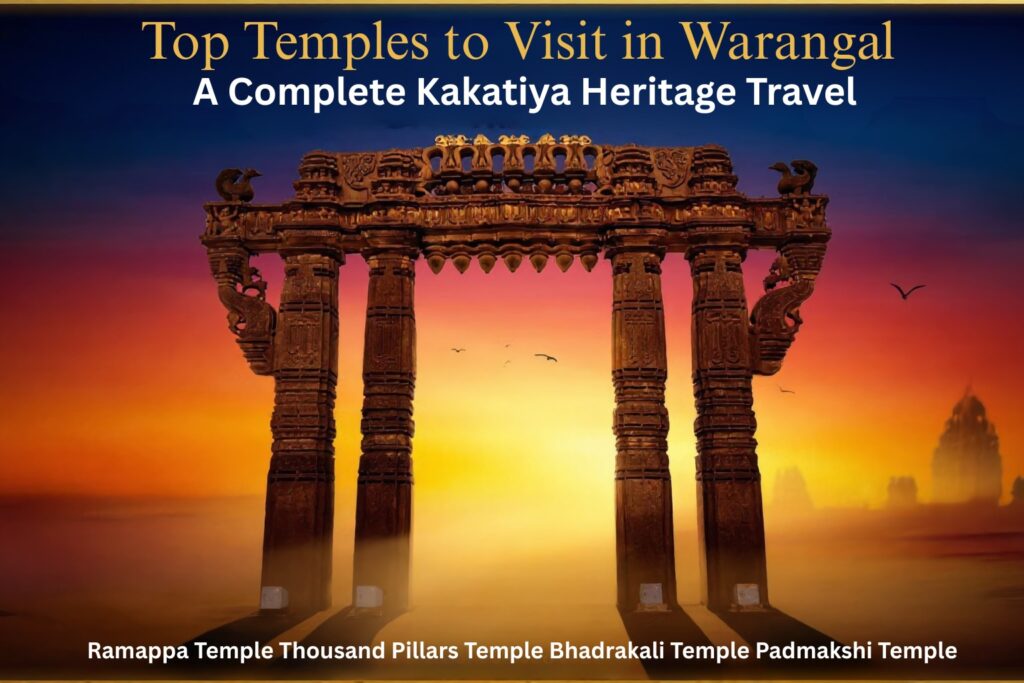
Explore the top temples to visit in Warangal including Ramappa Temple, Thousand Pillar Temple & Bhadrakali Temple. Complete heritage travel guide.
Whether you’re a pilgrim, history enthusiast, architecture lover, or weekend traveler from Hyderabad, Warangal’s temple circuit is a must-visit.
🏛️ Why Warangal is Famous for Temple Tourism
Warangal is celebrated for:
- Kakatiya-era architecture (12th–13th century)
- Intricate stone carvings and sculptures
- UNESCO World Heritage recognition
- Unique temple engineering techniques
- Blend of Shaiva, Vaishnava, Shakti & Jain traditions
The temples here are not just places of worship — they are architectural marvels that reflect the golden era of the Kakatiya dynasty.
🛕 1. Ramappa Temple (Rudreshwara Temple) – UNESCO World Heritage Site
Located near Palampet village, about 70 km from Warangal city, Ramappa Temple is the crown jewel of Kakatiya architecture.
Why It Is Special:
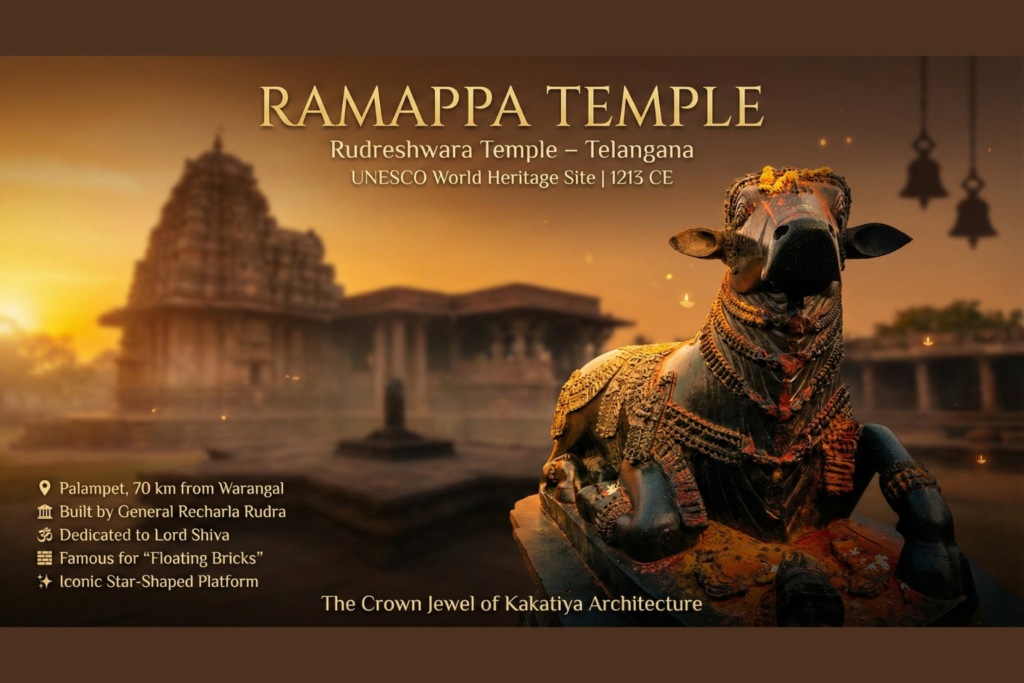
- Built in 1213 CE by General Recharla Rudra.
- Dedicated to Lord Shiva.
- Recognized as a UNESCO World Heritage Site.
- Famous for its “floating bricks” used in construction.
- Exquisite carvings of dancers, musicians, and mythological figures.
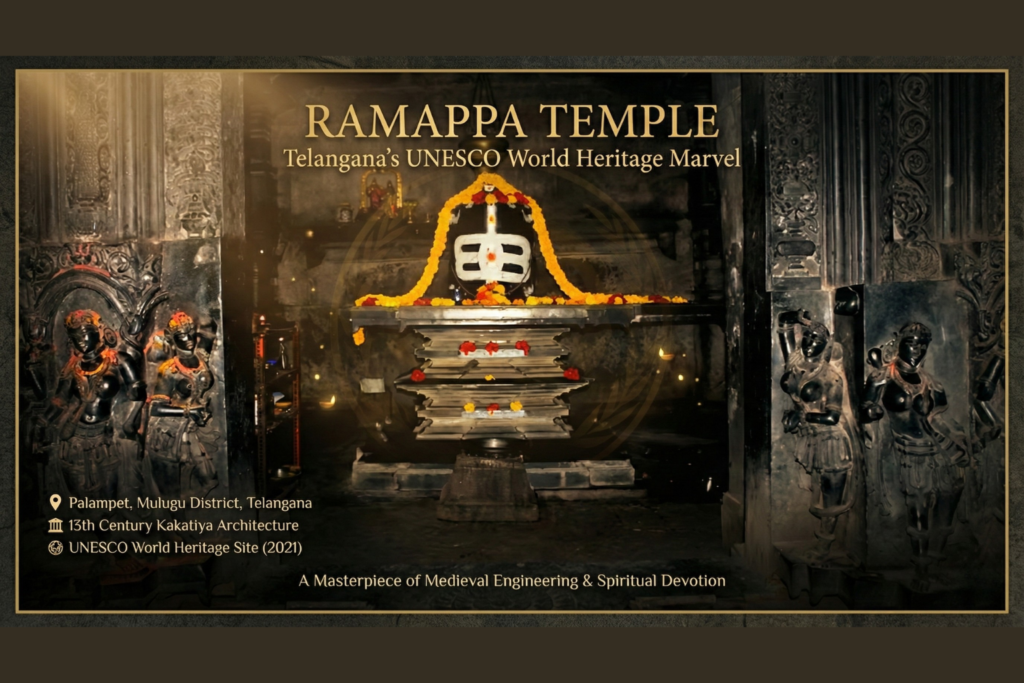
The temple stands on a star-shaped platform and features intricate sculptural panels that showcase extraordinary craftsmanship. The ceiling carvings and polished black basalt Nandi statue are particularly breathtaking.
This temple alone makes Warangal a global heritage destination.
🛕 Ramappa Temple (Rudreshwara Temple) – Telangana’s UNESCO Architectural Marvel
The Ramappa Temple, officially known as the Rudreshwara Temple, is one of India’s most extraordinary examples of medieval temple architecture and a UNESCO World Heritage Site. Nestled in the scenic village of Palampet in Mulugu district, Telangana, this temple is a striking testament to the artistic brilliance, engineering prowess, and spiritual devotion of the Kakatiya dynasty.
🌟 UNESCO World Heritage Recognition
In July 2021, the Ramappa Temple was inscribed on the UNESCO World Heritage List under the name Kakatiya Rudreshwara (Ramappa) Temple, Telangana. It is celebrated for its outstanding universal value, representing the peak of Kakatiya architectural and artistic achievement.
The UNESCO designation emphasizes the temple’s exquisite craftsmanship, remarkable engineering techniques, and cultural significance as a living monument of India’s rich heritage.
📜 History & Origins
The Ramappa Temple was constructed around 1213 CE during the reign of Ganapati Deva, one of the prominent rulers of the Kakatiya dynasty. The project was initiated by Recherla Rudra, a trusted general of the Kakatiya sovereign, under whose supervision the temple took shape.
What makes this temple especially unique is that it bears the name of its chief architect — Ramappa — rather than that of the deity it houses. This rare distinction reflects the extraordinary contribution of the sculptor Ramappa to its creation, and sets it apart among India’s vast number of historic temples.
Ancient texts and inscriptions reveal that the temple complex was built between 1212 and 1234 CE and originally comprised three shrines, with the main shrine dedicated to Lord Shiva (Ramalingeshwara Swamy).
🏛️ Architectural Brilliance
Ramappa Temple stands majestically on a 6-foot-high star-shaped platform, a design element that enhances both its aesthetic appeal and symbolic importance.
🔶 Key Architectural Features
Sandstone with Basalt Accents – The temple’s structure features reddish sandstone walls, while the outer columns display elaborate carvings on black basalt, a stone rich in iron and silica. These surfaces are adorned with a variety of motifs, including mythical animals, celestial dancers (Mandakinis), musicians, and floral designs, each carved with exquisite detail.
Floating Bricks & Sandbox Technique – One of the temple’s most fascinating features is its use of extremely lightweight bricks that can actually float on water. These were used in the construction of the roof superstructure (garbhalayam), and their buoyancy helped the structure withstand seismic activity over centuries. This technique — part of the sand-box foundation method — contributed significantly to the temple’s durability even through earthquakes and centuries of exposure.
Mandapa & Sculptural Space – The mandapa (hall) in front of the sanctum boasts intricately carved pillars placed so that they create a mesmerizing interplay of light and space, giving the interior an expansive and sacred feel.
Nandi and Shrine Layout – The temple complex includes two smaller Shiva shrines on either side of the main sanctuary. Facing the main sanctum is a massive Nandi statue, carved in black basalt and housed in its own pavilion, which draws devotees and art lovers alike.
🕉️ Religious Significance
Although Ramappa Temple is often admired for its architectural wonders, it is first and foremost a place of worship dedicated to Lord Shiva in the form of Ramalingeshwara Swamy. The temple has been, for centuries, a site of religious importance where devotees come to offer prayers, especially during Maha Shivaratri and other Shiva-related festivals.
For pilgrims, the temple is a living expression of faith where ancient ritual practices continue alongside its recognition as a cultural heritage site.
🛕 2. Thousand Pillar Temple (Sri Rudreshwara Swamy Temple)
Located in Hanamkonda, this 12th-century temple was built by King Rudra Deva in 1163 CE.
Highlights:
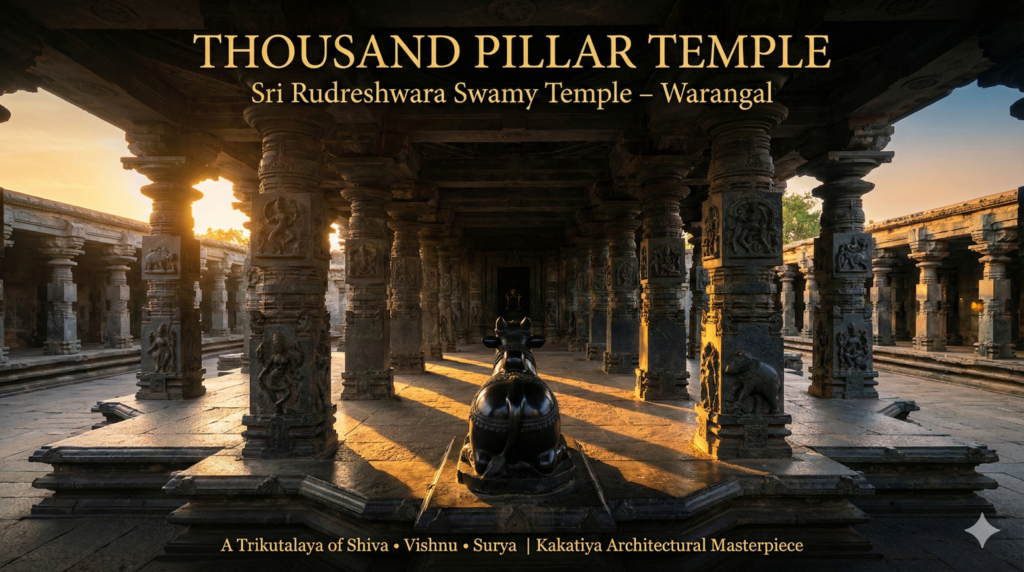
- Dedicated to Shiva, Vishnu, and Surya.
- Built in the Trikutalaya style (three sanctums).
- A massive hall supported by intricately carved pillars.
- Stunning Nandi statue carved from a single stone.
Though called the Thousand Pillar Temple, it features numerous sculpted pillars arranged in such a way that none obstruct the view of the deity — a brilliant example of architectural planning.
Ramappa Temple (Rudreshwara Temple) – Telangana’s UNESCO Architectural Marvel
The Ramappa Temple, officially known as the Rudreshwara Temple, is one of India’s most extraordinary examples of medieval temple architecture and a UNESCO World Heritage Site. Nestled in the scenic village of Palampet in Mulugu district, Telangana, this temple is a striking testament to the artistic brilliance, engineering prowess, and spiritual devotion of the Kakatiya dynasty..
🛕 Thousand Pillar Temple – A Marvel of Kakatiya Architecture
The Thousand Pillar Temple, officially known as Sri Rudreshwara Swamy Temple, is one of India’s most iconic medieval temples and a cornerstone of Kakatiya architectural heritage. Located in Hanamkonda, in the twin city region of Warangal, Telangana, this 12th-century temple is celebrated for its unique design, finely carved pillars, and rich mythological significance. It stands as one of the major attractions on the Warangal temple trail, alongside Ramappa Temple, Bhadrakali Temple, and Padmakshi Temple.
📜 Historical Legacy
The Thousand Pillar Temple was constructed during the reign of King Rudra Deva of the Kakatiya dynasty around 1163 CE. This was a period of flourishing art, temple building, and regional stability under the Kakatiya rulers, who established Warangal as a cultural and political center in South India.
The temple was envisioned as a syncretic space of worship — honoring three principal deities. Its design reflects not only religious devotion but also the engineering ingenuity and artistic richness of the period.
🏛️ Temple Layout & Religious Importance
🔱 Trikutalaya (Three-Shrine Structure)
The Thousand Pillar Temple is a Trikutalaya, meaning it contains three sanctums, each dedicated to a distinct deity:
- Shiva — as Rudreshwara Swamy
- Vishnu
- Surya — the Sun God
This unique threefold design makes it rare among Indian temples and showcases a spirit of religious harmony.
🔹 Central Hall & Pillars
The defining feature of the temple is its pillared hall, with each pillar elaborately carved to create an expansive and visually stunning interior. Although the name suggests “one thousand pillars,” the temple actually contains numerous intricately carved pillars that form an architectural labyrinth of light, shadow, and sculptural detail.
The placement and carvings of the pillars are so exquisitely crafted that they create unobstructed views toward the sanctums, demonstrating both technical skill and aesthetic vision.
🔹 Sculpted Legends
The temple walls and pillars are carved with depictions of divine figures, floral motifs, mythical beings, and geometric patterns — all showcasing the high level of craftsmanship characteristic of the Kakatiya era.
🏗️ Architectural Significance
The Thousand Pillar Temple is not just a religious site — it is an architectural masterpiece:
🔸 Star-Shaped Platforms
The temple structures are built on star-shaped platforms, a signature design seen in Kakatiya architecture that adds both visual complexity and symbolic resonance.
🔸 Intricate Stone Carvings
Each pillar is a work of art. Some illustrate dancers, musicians, gods and goddesses, and scenes from mythology. The level of detail is exceptional, especially considering the temple was sculpted in a time before modern tools.
🔸 Three Sancta Orientation
The orientation toward Shiva, Vishnu, and Surya demonstrates a broad religious embrace, blending Shaivism, Vaishnavism, and Surya worship within one sacred space.
These design elements show that the Thousand Pillar Temple was not only a place of worship but also a testament to spatial planning, devotional inclusivity, and sculptural brilliance.
🛐 Spiritual & Religious Importance
The temple attracts devotees from across India, especially during festivals such as:
- Mahashivaratri
- Vaisakha Poornima
- Ekadashi days
- Surya worship festivals
Devotees visit to seek blessings from multiple deities in a single sacred location — a feature that makes this temple spiritually inclusive and architecturally unique.
This temple is one of the most visited pilgrimage sites in Telangana.
🛕 3. Bhadrakali Temple – Divine Power by the Lake
What Makes It Unique:
- An ancient temple dating back to the Chalukya period.
- Massive stone idol of Bhadrakali.
- Scenic location beside Bhadrakali Lake.
- Popular during festivals like Dasara and Navratri.
The peaceful lakeside setting makes it a perfect blend of devotion and natural beauty. Early morning and sunset visits offer stunning views.
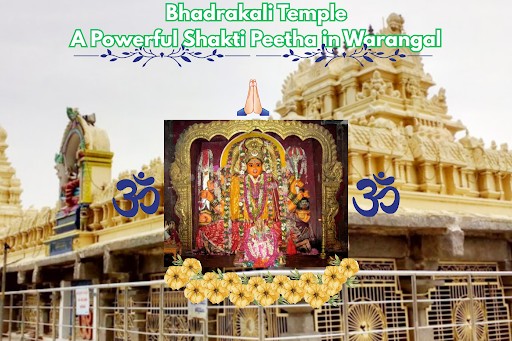
Bhadrakali Temple, Warangal
A Powerful Shakti Peetha Overlooking a Serene Lake
Overview
The Bhadrakali Temple is one of the most revered and ancient temples in Warangal, dedicated to Goddess Bhadrakali, a fierce and protective form of Goddess Parvati. Situated on a hillock between Warangal and Hanamkonda, the temple overlooks the scenic Bhadrakali Lake, offering a breathtaking combination of spirituality and natural beauty.
This temple is not just a place of worship — it is an important spiritual landmark deeply connected with the region’s early dynasties and religious history.
Historical Background
The Bhadrakali Temple is believed to have been originally built in 625 CE by the Chalukya dynasty, making it one of the oldest temples in Telangana. Later, it was expanded and patronized by the Kakatiya rulers, who greatly contributed to temple architecture in Warangal.
Architectural Features
The temple reflects a blend of Chalukyan and Kakatiya architectural styles.
🔹 Main Deity
The presiding deity, Goddess Bhadrakali, is represented by a massive stone idol seated in a fierce yet protective posture. The idol is adorned with weapons symbolizing divine power and protection.
🔹 Temple Structure
- Simple yet powerful stone architecture
- A large courtyard accommodating devotees during festivals
- Traditional Dravidian temple design elements
- Scenic lake backdrop enhancing spiritual ambiance
Unlike some intricately carved Kakatiya temples, Bhadrakali Temple’s strength lies in its raw spiritual presence and hilltop setting.
Spiritual Significance
Bhadrakali Temple is considered one of the most powerful Shakti temples in Telangana. Devotees visit to seek:
- Protection from negativity
- Strength and courage
- Relief from obstacles
- Blessings for prosperity
During Navaratri, the temple attracts thousands of devotees from across Telangana
🛕 4. Padmakshi Temple – Jain & Hindu Heritage
Key Features:
- Black granite pillar with four faces.
- Sculptures of Jain Tirthankaras.
- Located on a hill offering panoramic views.
It showcases Warangal’s diverse religious history and cultural inclusivity.
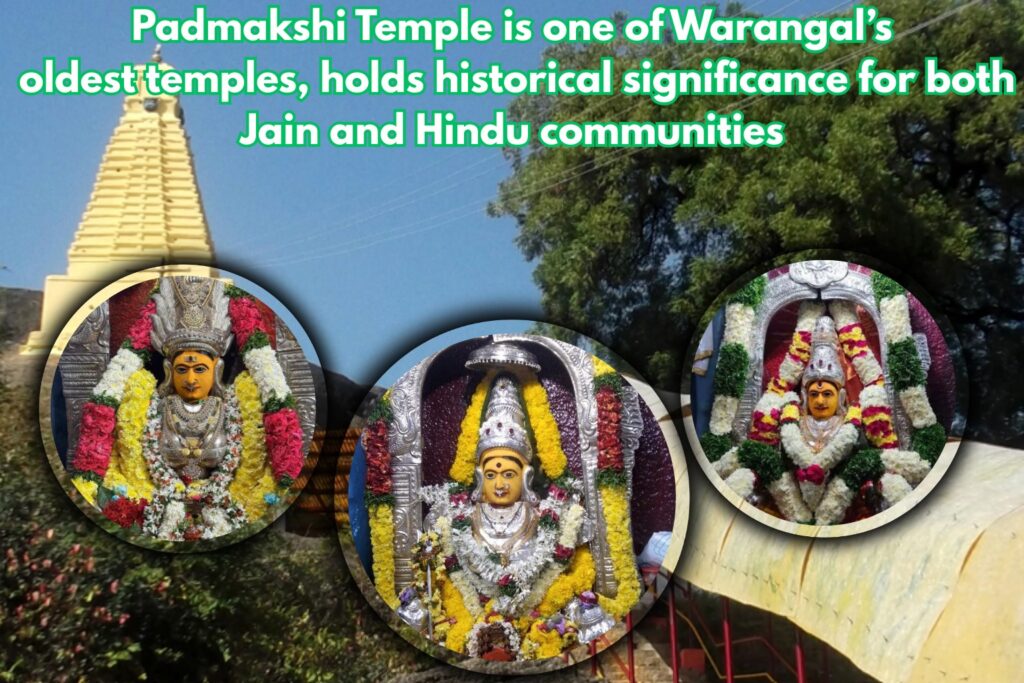
🛕 Padmakshi Temple, Warangal
A Rare Jain–Hindu Heritage Site
Overview
The Padmakshi Temple, located in Hanamkonda, is a historically significant temple that showcases a rare blend of Jain and Hindu religious traditions. The temple is dedicated to Goddess Padmakshi, believed to be an incarnation of Goddess Lakshmi.
This temple stands as a testimony to Warangal’s religious diversity and architectural evolution.
Historical Background
Padmakshi Temple dates back to the 12th century and is believed to have Jain origins before being converted into a Hindu temple during the Kakatiya rule.
Architectural Highlights
🔹 Jain Influence
The temple complex includes:
- A black granite pillar with four faces (often associated with Jain iconography)
- Carvings of Jain Tirthankaras
- Minimalistic stone carvings compared to other Kakatiya temples
🔹 Hindu Elements
Over time, the temple evolved into a Hindu shrine dedicated to Goddess Padmakshi. Devotees worship the goddess for prosperity and well-being.
🔹 Elevated Location
The temple sits on a small hill, providing:
- Elevated panoramic views of Hanamkonda
- Peaceful surroundings
- A calm and less crowded spiritual experience
Spiritual Significance
Padmakshi Temple is particularly visited by devotees seeking:
- Wealth and prosperity
- Family well-being
- Spiritual clarity
Although smaller in scale compared to Bhadrakali and Ramappa temples, Padmakshi Temple holds immense cultural and historical value.
🏰 5. Warangal Fort – Kakatiya Grandeur
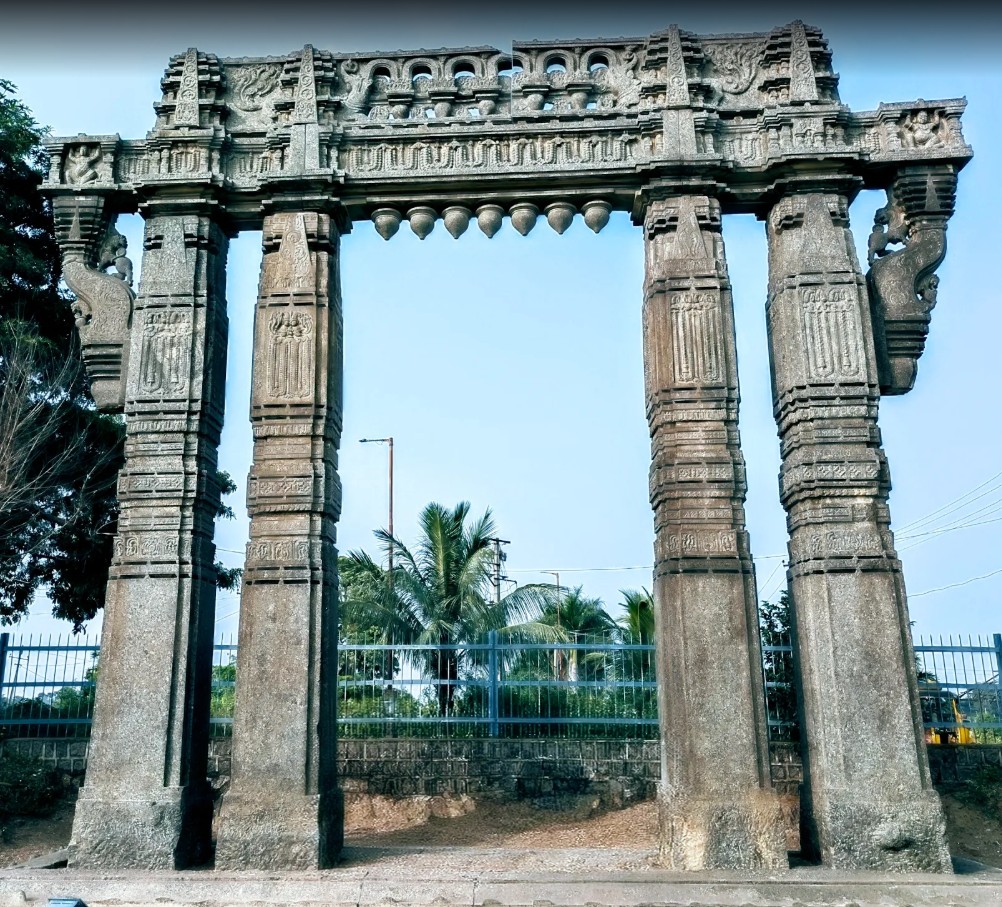
Though technically a fort, Warangal Fort contains temple ruins and majestic gateways known as “Kakatiya Kala Thoranam.”
Highlights:
- Massive stone gateways.
- Ruins of ancient temples.
- Intricate stone sculptures.
- Symbol of Telangana state heritage.
The fort complex reflects the power and artistic excellence of the Kakatiya rulers.
🏛️ Architectural Significance of Warangal Temples
Warangal temples are known for:
- Star-shaped platforms
- Sandstone and black basalt sculptures
- Intricate pillar carvings
- Advanced temple engineering
- Earthquake-resistant construction
The Kakatiya artisans achieved unmatched detail in stone work, making these temples architectural masterpieces.
🚘 YoDrives Travel Options for Warangal Temple Trip
YoDrives offers flexible and comfortable ground transportation solutions tailored for pilgrimage journeys.
🚗 Self-Drive Cars
🚘 Chauffeur-Driven Cars
🚌 Tempo Travellers (10–26 Seaters)
🚌 Mini Buses & Buses (Up to 50 Seaters)
🚙 Luxury Car Rentals
❓ FAQs – Warangal Temple Trip with YoDrives
1. How far is Warangal from Hyderabad?
Warangal is approximately 150 km from Hyderabad, and the journey takes around 3 to 4 hours by road, depending on traffic and route conditions.
2. What is the best way to travel from Hyderabad to Warangal temples?
The most convenient way is by road travel, as it allows flexibility to visit multiple temples like Ramappa Temple, Thousand Pillar Temple, Bhadrakali Temple, and Padmakshi Temple in a single trip.
YoDrives offers self drive cars, chauffeur-driven vehicles, tempo travellers, and buses for comfortable temple travel.
3. Can I visit all major Warangal temples in one day?
While it is possible to visit Thousand Pillar Temple, Bhadrakali Temple, and Warangal Fort in one day, Ramappa Temple is located about 70 km away from Warangal city and is better covered in a 2-day itinerary for a relaxed experience.
4. Does YoDrives provide self-drive cars for Warangal temple trips?
Yes. YoDrives provides self-drive car rentals, allowing families and small groups to travel with complete schedule flexibility and privacy.
5. Are chauffeur driven cars available for temple visits in Warangal?
Yes. YoDrives offers chauffeur driven vehicles, which are ideal for senior citizens and devotees who prefer a relaxed, stress-free pilgrimage journey.
6. Is a tempo traveller available for group temple tours in Warangal?
Yes. YoDrives provides 10–26-seater tempo travellers, perfect for extended families, bhajan groups, and community darshan trips to Warangal temples.
7. Can large pilgrimage groups book buses for Warangal temple tours?
Yes. YoDrives offers mini buses and full-size buses (up to 50-seaters), suitable for large pilgrimage groups and temple tour organizers.
8. What is the best time to visit Warangal temples?
The ideal time to visit Warangal temples is between October and February, when the weather is pleasant. Early mornings are best for peaceful darshan and photography.
9. Is Ramappa Temple a UNESCO World Heritage Site?
Yes. Ramappa Temple (Rudreshwara Temple) was declared a UNESCO World Heritage Site in 2021 for its exceptional Kakatiya architecture and floating brick construction.
10. Can I plan a weekend temple trip from Hyderabad to Warangal?
Yes. Warangal is an ideal weekend spiritual getaway from Hyderabad. With YoDrives, you can choose flexible rental durations for same-day return or 2-day temple trips.
🏁 Conclusion
A trip to temples in Warangal is a journey into Telangana’s glorious past. From the world-renowned Ramappa Temple to the majestic Thousand Pillar Temple and the serene Bhadrakali Temple, every monument tells a story of devotion, power, and artistic brilliance.
Whether you are seeking spiritual peace, architectural inspiration, or a meaningful weekend escape from Hyderabad, Warangal’s temple circuit offers a complete cultural and devotional experience.
Warangal stands as a timeless testament to the legacy of the Kakatiya dynasty — a destination every traveler must explore at least once.
